A moment of juiciness
‘People often assume botanical artists spend their days painting flowers in complete silence while listening to birdsong and contemplating the meaning of a petal’.
I hate to disappoint them.
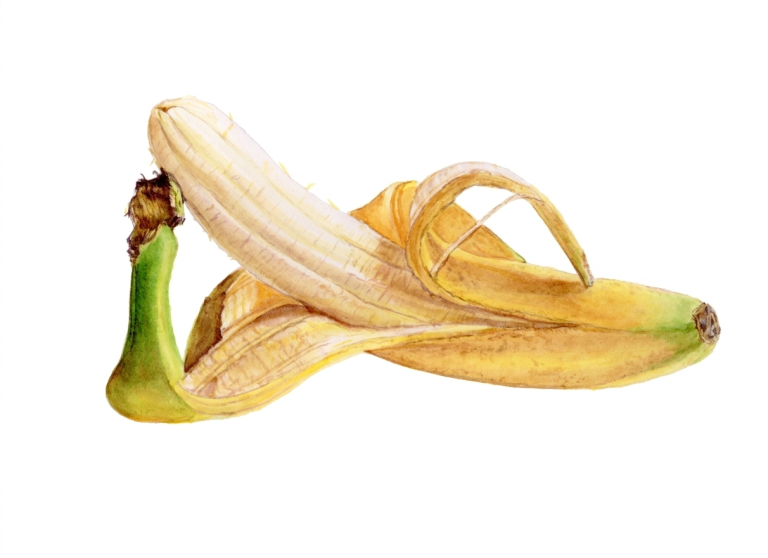
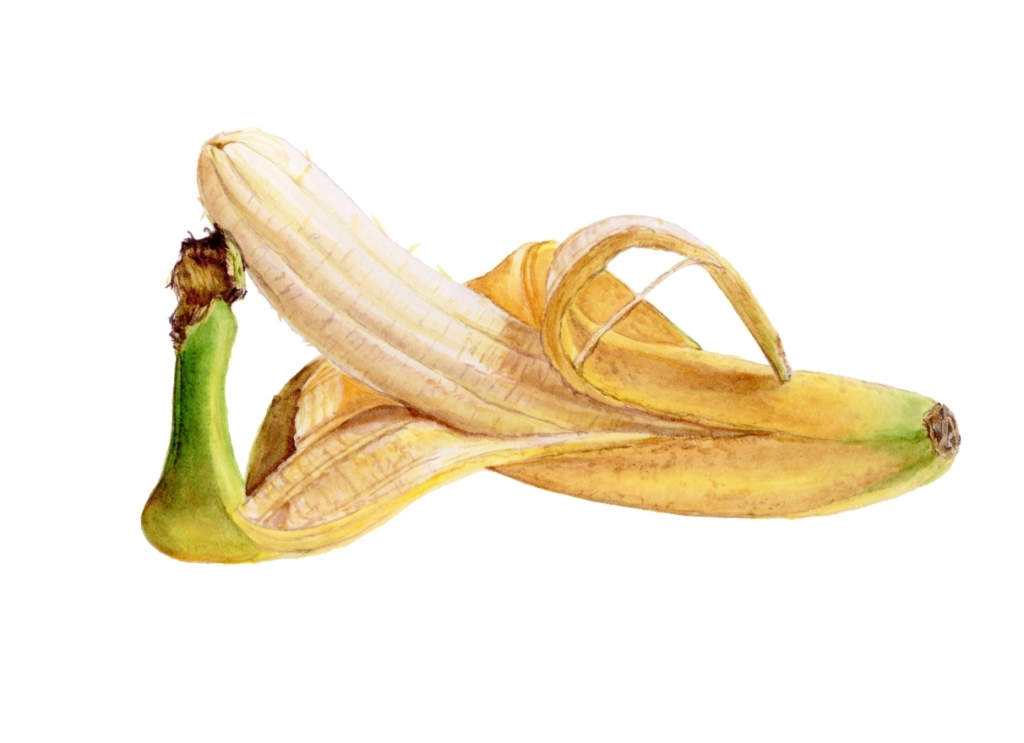
Because one of the most important paintings in my studio career was a banana.
Not a rare tropical banana and not a scientifically significant specimen, just a banana with attitude, a banana that looked as if it had spent far too much time admiring itself in the mirror, a banana that became known as Posing Banana.
And somehow, quite unexpectedly, that banana changed everything for me.
The Painting That Started Everything
For years I painted plants in a traditional way, focusing on leaves, flowers, fruits and seeds, built on careful observation, botanical accuracy and deep respect for the subject.
I still love that discipline.
There is something quietly powerful about studying a plant closely enough to notice details most people never see, the way light sits on a petal or how a stem carries its own kind of quiet architecture.
But alongside that, there was always another part of me waiting in the background, the part that notices personality everywhere, the part that laughs at things, the part that looks at a carrot and thinks it is slightly too proud of itself.
At some point I stopped ignoring that voice and painted Posing Banana.
The painting itself was simple, but the banana felt completely convinced of its own importance, as if it was performing rather than simply existing. It had presence, confidence and a slightly ridiculous sense of self-awareness.
The banana knew it was being watched and, even more importantly, it seemed to enjoy it.
To my surprise, people loved it.
Even more surprisingly, Saatchi Art decided to advertise it.
Out of all the flowers, leaves and carefully observed botanical studies I had created, it was the banana with an oversized personality that suddenly drew attention.
I probably should have understood what that meant at the time, but instead I simply felt slightly confused and amused by the situation.
What I Discovered in Exhibition Rooms
Then I began taking the painting to exhibitions and that is where things truly came alive.
I discovered something very simple but powerful: people rarely walk past a painting of a banana without reacting.
Especially when the banana appears to have more self-confidence than most humans in the room.
Visitors would stop, smile, laugh, call friends over, point at it and sometimes take photographs, often trying very hard not to laugh and failing completely.
I watched this happen again and again and each time I realised the same thing.
The painting created an instant connection.
People who would normally walk past artworks suddenly paused, as if the banana had quietly interrupted their expectations.
It was not asking to be admired in a serious way, it was inviting people to enjoy themselves.
Standing in exhibitions and watching strangers smile at a piece of fruit made me start thinking differently about what I was doing.
What if this banana was not an exception?
What if there were more characters waiting to appear?
Power root – Rikishi
Hug
Scatting carrot
Building an Anthropomorphic Botanical World
That thought became the beginning of my anthropomorphic fruit and vegetable collection, a body of work where I give plants human qualities, emotions and behaviour, allowing them to become characters with their own presence and stories.
Sometimes I think of it as a world where vegetables have richer social lives than most people imagine.
The next arrivals were carrots but not ordinary carrots in any sense.
These were anthropomorphic plant portraits with ambition, personality and attitude, each one carrying its own emotional direction.
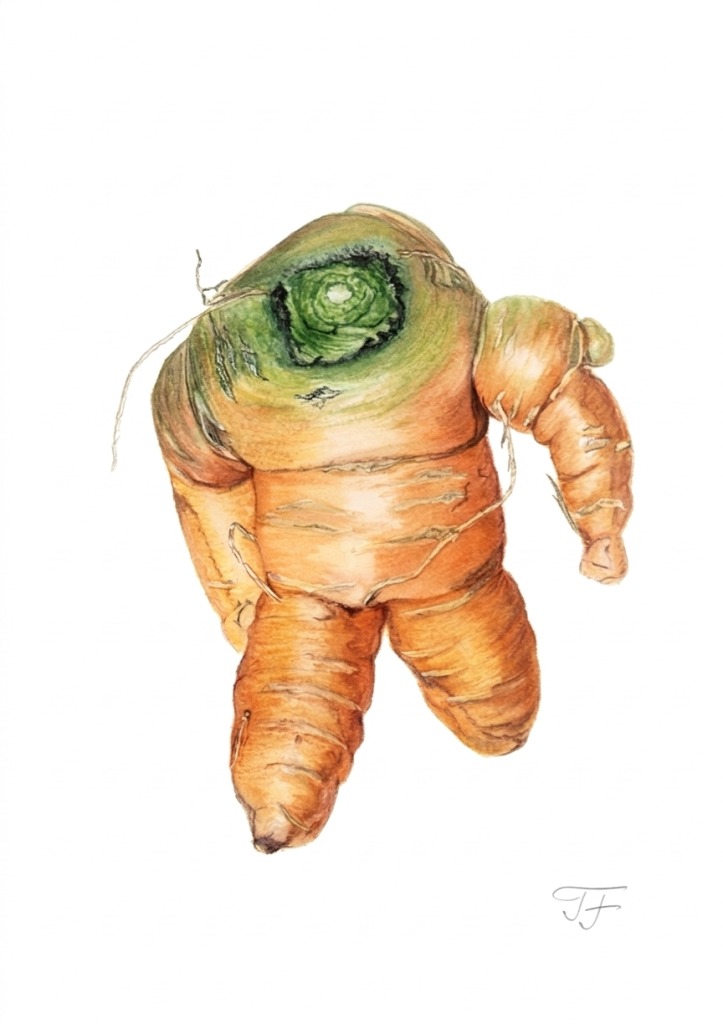
The first was Power Root-Rikishi, a carrot that seemed to take life very seriously, the kind of character that approaches everything with discipline and determination, as if it is always preparing for something important, possibly even before breakfast.
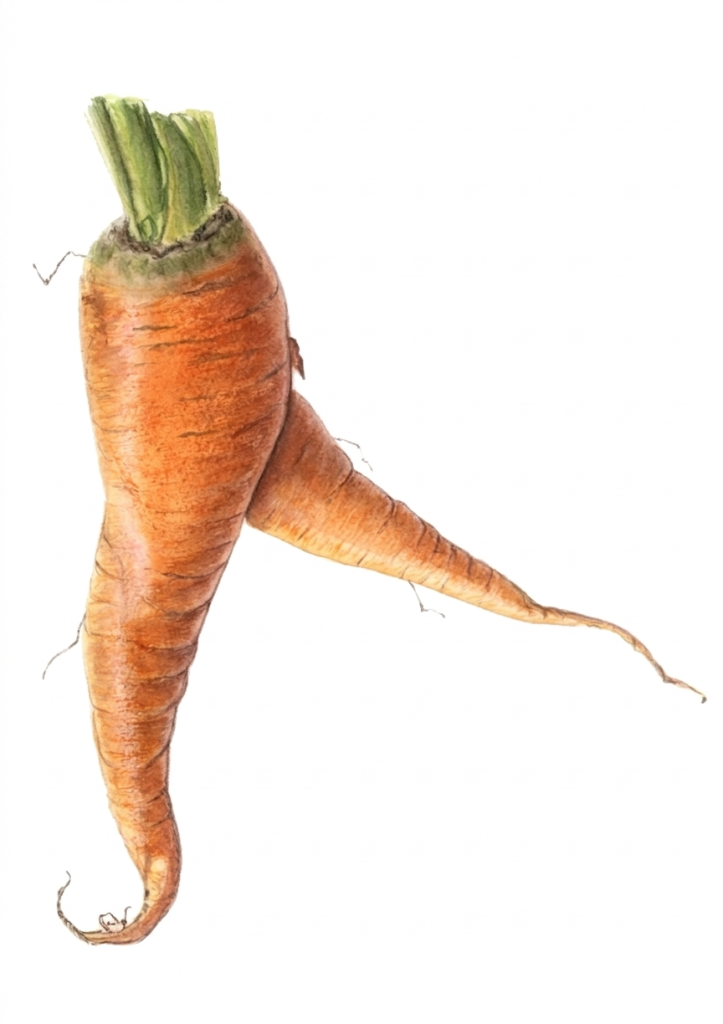
Then came Skating Carrot, a completely different energy, full of movement, curiosity and playful confidence. I liked the idea that something usually associated with stillness underground could instead become a character defined by motion, balance and the willingness to fall and try again.
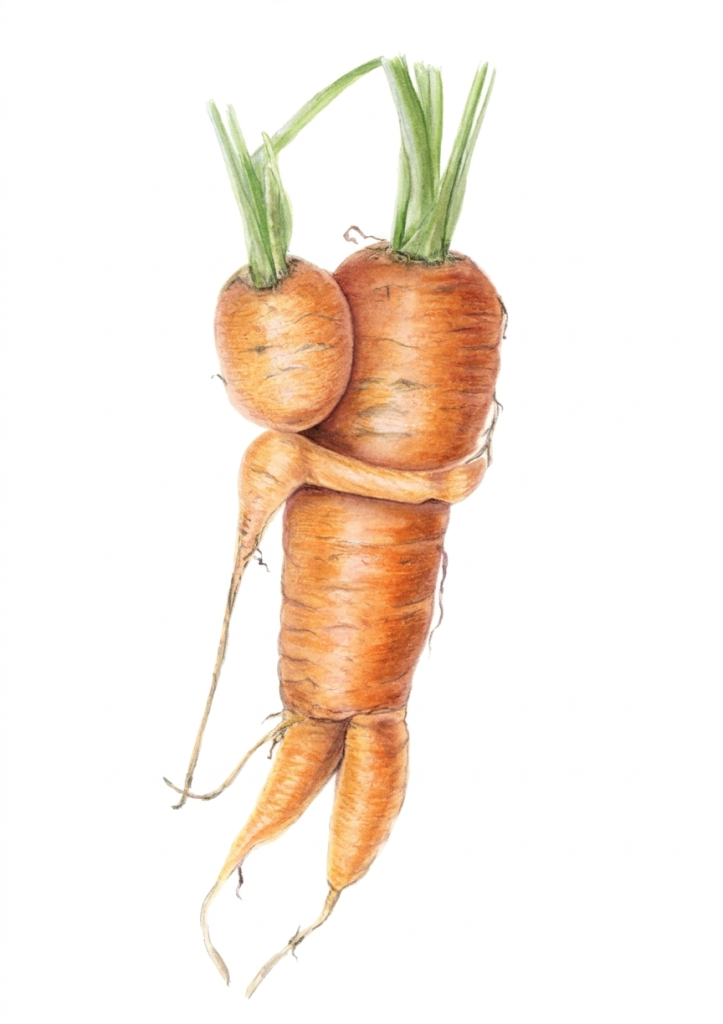
After that came Hug, one of my personal favourites, because it carries something very simple but very necessary. It suggests that sometimes intelligence, analysis and explanation are not the answer and what is needed instead is warmth, comfort and connection. Even more so when that feeling is expressed through something as unexpected as carrots.
By this point I realised I was no longer simply painting botanical subjects.
I was building an anthropomorphic world where fruit and vegetables were no longer passive objects of observation but active characters with emotional lives, reflections of human behaviour seen through a different lens.
Some carried friendship and loyalty, others showed joy, humour or determination, while a few revealed vanity, pride or quiet absurdity. Together they created a strange but familiar mirror of human experience.
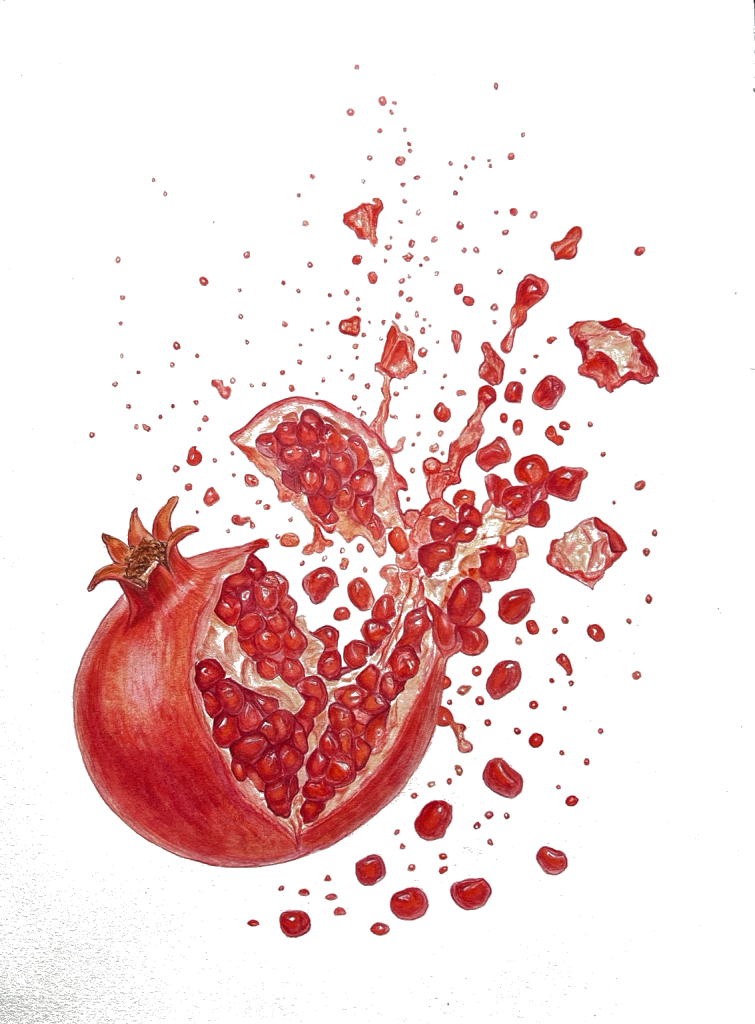
Juicy Scandal
Juicy Scandal and the Fastest Sale I Have Made
Then came the pomegranates.
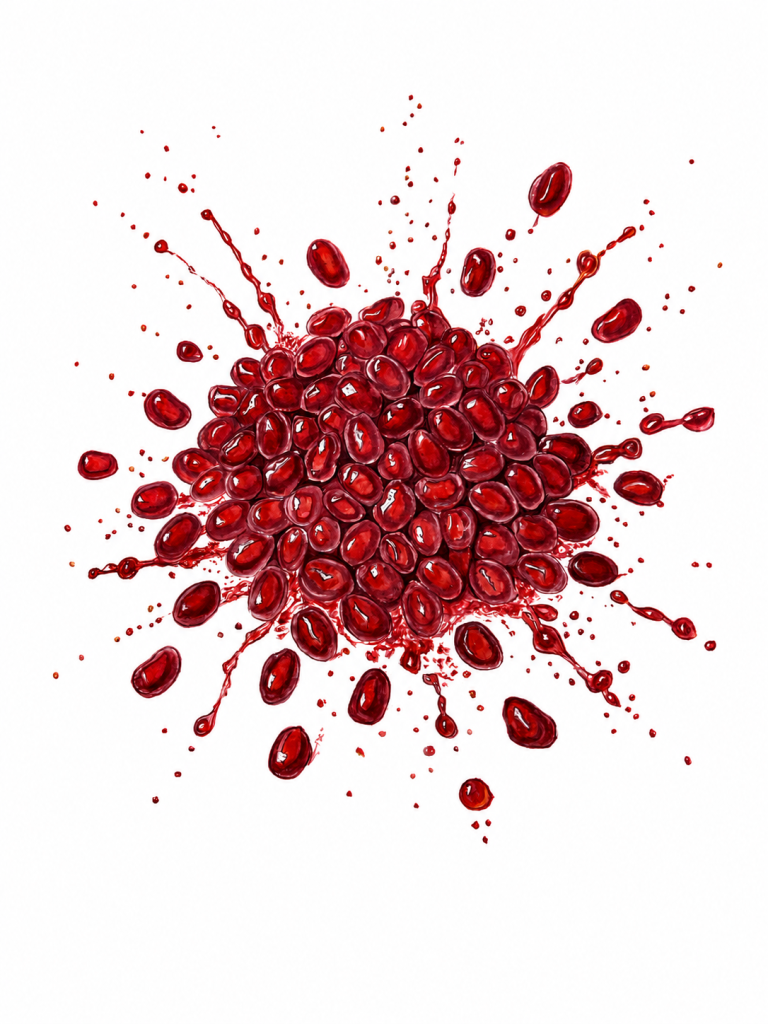
Or more specifically, Juicy Scandal.
I still think about that painting with a smile, because pomegranates already feel slightly dramatic by nature, as if they are holding something secret inside them, something about to burst out at any moment.
They are beautiful on the outside and chaotic on the inside which made them perfect for storytelling.
When I painted Juicy Scandal I knew I liked it but I had no idea what would happen next.
The morning after I finished it someone saw a photograph of the painting on my phone.
Not a gallery image, not a printed catalogue, just a quick photo on my screen.
They looked at it and immediately said, “I love it. I buy it.”
There was no hesitation, no discussion and no process.
Just instant connection.
Honestly, it was one of the fastest sales I have ever experienced, and it made me laugh because it felt so instinctive and emotional at the same time.
The painting was gone almost before it had time to feel finished.
Moments like that remind me that art is far less predictable than we like to believe.
You can spend weeks working on something carefully, thoughtfully and technically and then a completely different piece suddenly creates an immediate emotional response.
It is never fully in your control.
And I like that.
Because it keeps the work alive.
Why Humour Has a Place in Botanical Art
What I enjoy most about creating these anthropomorphic botanical stories is that humour is often missing from traditional botanical art, even though plants themselves are already full of character if you choose to see them that way.
Botanical painting has a long and respected history built on observation, structure and scientific accuracy and I deeply respect that tradition, as I am part of it myself.
But I also believe there is room for something else alongside it.
There is room for laughter.
There is room for imagination.
There is room for plants that behave like people in slightly unexpected ways.
When I look at my work in exhibitions, I often see the same sequence repeat itself.
People approach with curiosity, then pause, then smile and finally laugh before starting a conversation.
That moment of shared reaction is very important to me, because it turns a painting into an experience rather than just an image on a wall.
Art does not always need to be serious in order to be meaningful.
Sometimes making someone smile is meaningful enough.
Sometimes giving someone a small moment of lightness during a heavy day is meaningful enough.
Sometimes reminding adults that playfulness still exists is meaningful enough.
I think this is often underestimated.
The world already provides enough seriousness on its own.
A self-important banana, a skating carrot or a pomegranate full of drama can offer something else entirely.
So the collection continues to grow.
New characters appear without warning and I never fully know who will arrive next.
A rebellious beetroot perhaps.
A dramatic pear.
An onion with too many opinions.
Nothing would surprise me anymore.
What began with one posing banana has slowly become a growing anthropomorphic world of fruit and vegetable personalities, each one carrying a small story, a small emotion and a slightly exaggerated sense of life.
And I find that endlessly interesting.
Because somewhere between botanical accuracy and imagination I found a space that feels completely my own.
A place where plants are no longer silent.
A place where carrots can skate.
A place where pomegranates create scandals.
And a place where one very confident banana quietly started a small revolution.
ABOUT THE AUTHOR
Inessa Falina is a London-based botanical artist and teacher. A member of the Chelsea Physic Garden Florilegium Society, she has exhibited at The Mall Galleries and Chelsea Old Town Hall, with work held in private collections across Europe, the USA and Australia. Through her art and teaching, she helps people slow down, observe nature deeply and find calm through the practice of painting. You can follow her work on Instagram at @inessa.falina
— Inessa