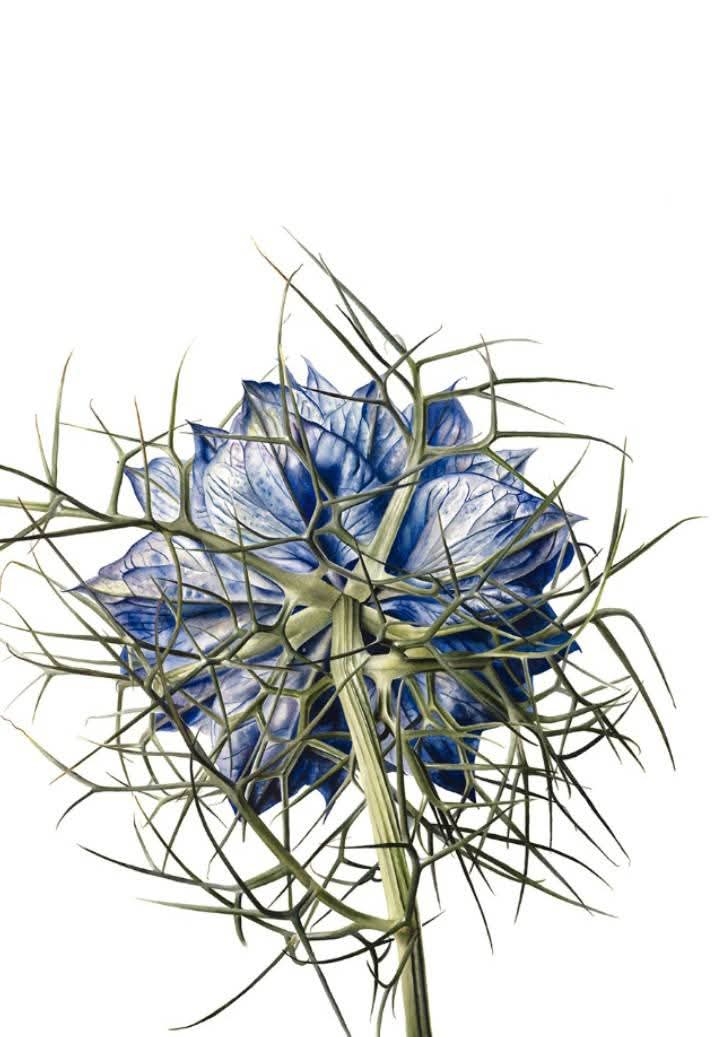
A Conversation with Botanical Artist Svetlana Lansе Hosted by Inessa Falina
Discovering the character, light and beauty within botanical art
In The Botanical Conversations, I invite botanical artists to share the stories behind their work — their creative journeys, techniques, inspirations and the personal connection they develop with the natural world.
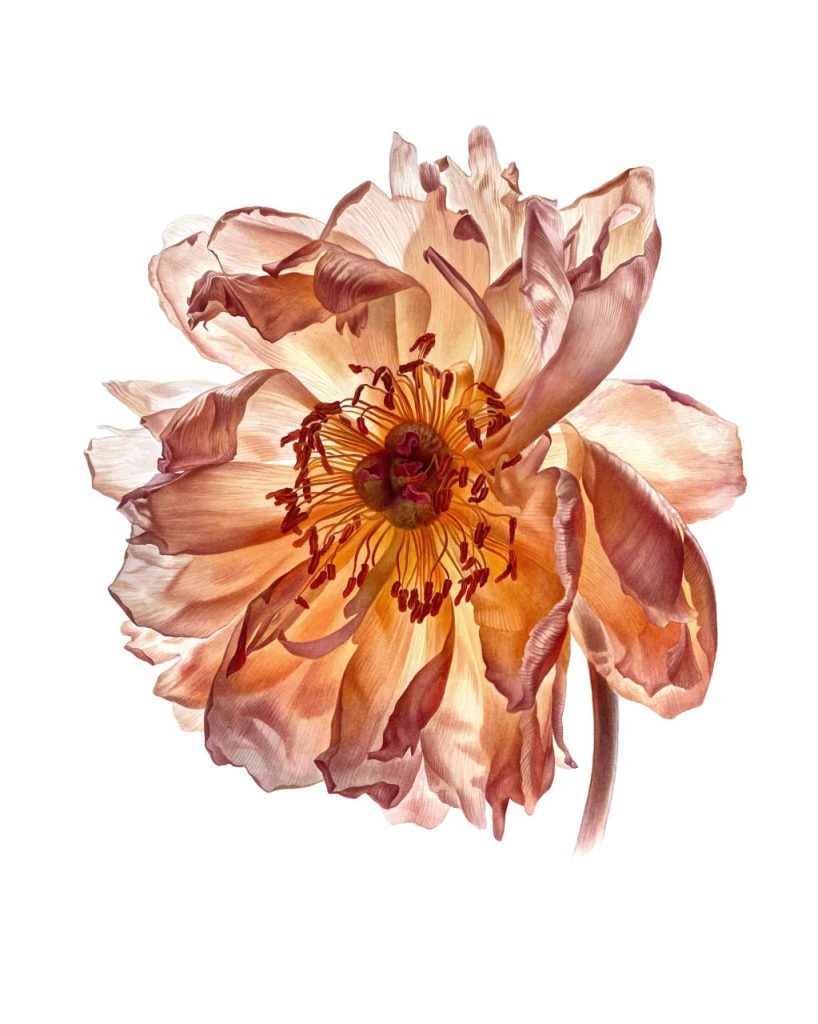
Tenderness by Svetlana Lanse
For the first conversation in this series, I am delighted to introduce botanical artist, miniaturist and educator Svetlana Lansе.
Svetlana’s work immediately caught my attention when I first saw one of her paintings at Plantae Exhibition at the Mall Galleries in London. The technical skill was extraordinary but what fascinated me most was something deeper. Her painting seemed to reveal more than the botanical structure of the plant. It seemed to capture its personality.
Recently, I had the opportunity to watch Svetlana preparing to paint a new subject. Before beginning she carefully photographed the plant from different angles, studying its form, colour and light. Watching her, I realised that for artists like Svetlana, the painting begins long before the brush touches the paper.
It begins with a relationship between artist and plant.
Svetlana Lanse is a member of the Society of Botanical Artists and the Chelsea Physic Garden Florilegium Society. Her work is held in prestigious collections including the Hunt Institute for Botanical Documentation and the Shirley Sherwood Collection. With her background in miniature and decorative painting from St Petersburg, Svetlana has developed a distinctive approach that combines exceptional precision with a deep sensitivity to the character and beauty of plants.
In this conversation we explore her artistic journey, the importance of choosing the right subject, her unique approach to light and colour, teaching philosophy and why every plant has a story waiting to be discovered.
The painting begins with observation
Inessa: Svetlana, before we begin, thank you so much for joining me for this conversation. It is a pleasure to have the opportunity to talk with you about your artistic journey and your approach to botanical painting.
Before we start, may I ask your permission to record this interview? The recording will only be used to help me prepare the final article accurately and make sure I don’t miss any of your wonderful insights.
Svetlana: Yes, of course. Thank you for inviting me. You can record everything today
Inessa: The first time I saw your work I was struck not only by the incredible detail and beautiful colours but also by the feeling that you had painted more than the plant itself. It felt as though you had captured its inner life.
Recently I watched you taking reference photographs of a plant before painting. You moved around it slowly, observing it from different angles, almost as though you were getting to know it. Is that how your botanical painting process begins?
Svetlana: Yes, of course. I think having a very unique subject to paint is important. You start your botanical artwork with observation and choosing — choosing the right angle, the right light and the right object.
I had one example with tomatoes. I started painting ordinary red tomatoes, the kind you can easily buy in a shop. Later I grew my own tomatoes and chose black tomatoes with very interesting shades of violet and green. I realised how different it was because the subject itself meant so much.
The beginning of a botanical artwork is not only painting. It is observing, choosing and discovering what makes the subject special.
Inessa: I completely agree. I think this is one of the things that makes botanical art so fascinating. The artist’s relationship with the subject begins before any paint is applied.
From miniature painting to botanical art
Inessa: Your artistic journey began with training in miniature and decorative painting, as well as academic drawing and painting. How has this background influenced the way you observe and paint plants today?
Svetlana: Not only those two fields — I also trained in academic drawing and painting. When I started my career, I wasn’t very strong in botany itself but I was very good at copying details and shapes.
I copied every detail I saw and my botanical illustrations were accurate but without a deep understanding of what I was drawing and painting. Later, I developed my botanical knowledge and I am still continuing to learn.
But I believe that my early training in careful observation and copying helped me enormously in my botanical studies.
Inessa: I find this very interesting because it shows that botanical art is built from many different skills. Technical ability, observation and botanical knowledge all develop together over time.
Your early training gave you the discipline to see details accurately but your later botanical studies gave those details meaning. Looking at your paintings today it feels as though precision and artistic expression have come together naturally.
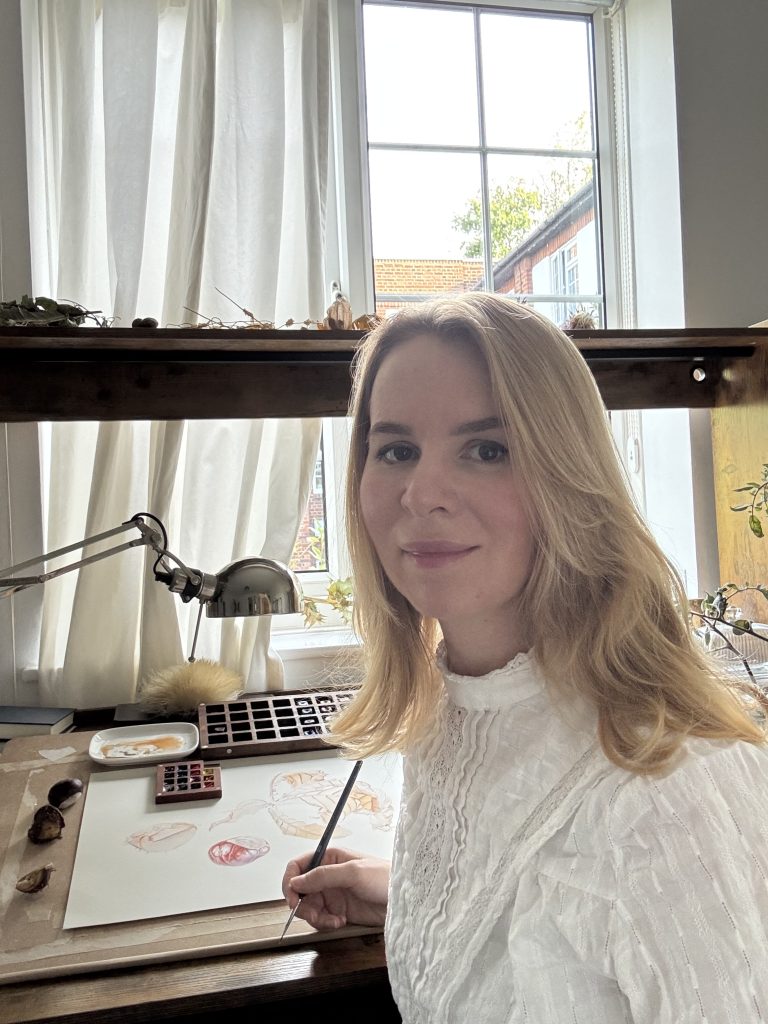
Svetlana Lanse in her studio
Finding beauty in ageing plants
Inessa: Many botanical artists are drawn to flowers at their perfect moment — when they are fresh, open and full of colour. Yet you often choose dried leaves, seed pods and plants that have already changed with time. What attracts you to these subjects?
Svetlana: I think at some point it is true that I don’t really like painting perfect green leaves — I am joking but maybe there is some truth in it!
I like it when nature does something to my subjects and makes them more picturesque. When plants age, dry or change colour they often develop something unique. My role is only to copy that and perhaps highlight the special details that nature has created.
I don’t need to invent anything. I start with what nature has already made.
Inessa: This is something that really stands out in your work. Your paintings are botanically accurate, but they never feel like simple copies. Each plant seems to have its own personality.
There is a sense of portraiture in your botanical art — as though you are introducing us to an individual rather than showing us only a specimen.
Svetlana: Thank you. I think this comes from my interest in portraits. Every plant is like a person to me, so I try to show its character deeply.
Choosing a subject: when inspiration appears
Inessa: When you choose a new subject, what attracts you first? Is it the botanical structure, the colours, the story behind the plant or simply an emotional connection?
Svetlana: I must admit, usually it is the appearance. It is the beautiful colours, the transparent parts and the feeling that I can bring light into the painting.
When I see something like that I know immediately that it is what I want to paint. It is like falling in love every time. There is a moment when you see the subject and you know: this is the one.
Inessa: I love this description because I think many artists recognise that feeling. Sometimes the choice of subject is not a logical decision. Something simply catches your attention and creates a connection.
That first emotional response can become the beginning of an entire painting.
Creating light, depth and luminosity
Inessa: One of the qualities that immediately attracts me in your paintings is the extraordinary sense of light. Your flowers seem almost illuminated from within. Could you tell us how you developed this approach?
Svetlana: I think it started in 2017 when I was painting a beautiful dried red maple leaf. I realised there are two different types of colours.
Some colours help me build volume. They have a strong ability for tonal studies, and they make it easier to create form. Other colours — such as greens, gold, opera rose and transparent yellows — are more about creating luminous effects.
I usually begin my paintings by building volume and structure. After that, I glaze the artwork with hundreds of very thin layers, sometimes almost like tea washes but with very vibrant colours.
I move from natural colours towards these luminous effects.
Inessa: This explains so much about the feeling of your paintings. There is a wonderful balance between structure and atmosphere. The botanical accuracy gives the foundation, but the layers of colour create emotion and light.
A personal discovery: combining watercolour and oil
Inessa: Your paintings have such incredible depth and luminosity. I know that you sometimes combine watercolour with oil in your work. Could you tell us how this technique developed?
Svetlana: Yes, this is true and it is my own technique. I never really share the complete process with other artists because it feels very personal — it is like my child.
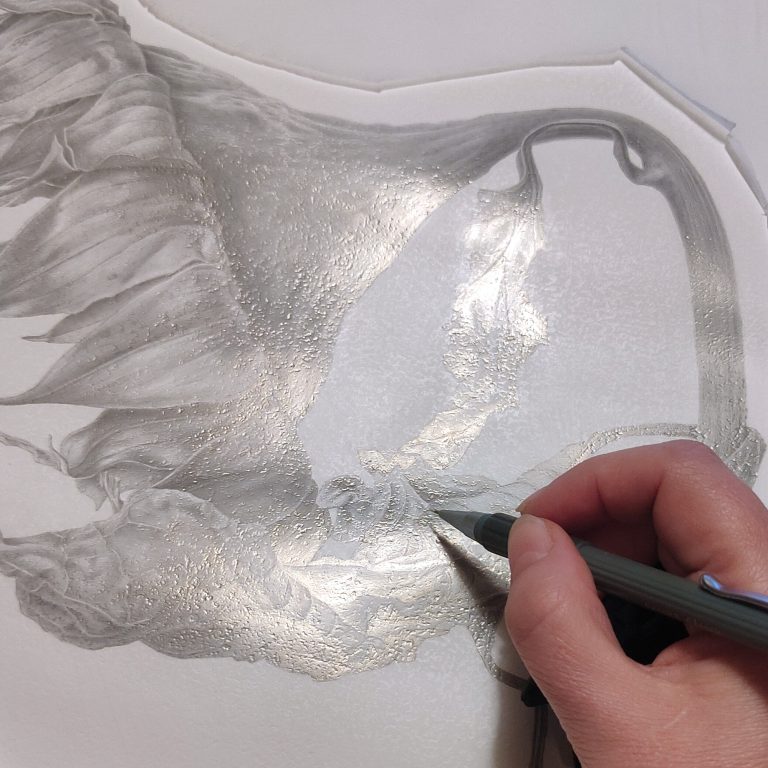
For many years I painted with oils on paper. At some point, I realised that I could tint my paper slightly with watercolour, then apply a clear primer and continue the artwork with oils.
The watercolour underneath creates a subtle foundation and the oil layers bring depth and a beautiful slightly reflective quality. It reminds me of the effect we love in paintings created on vellum because there is a certain richness and transparency.
It works beautifully, and I still use this approach in my work.
Inessa: It sounds like one of those discoveries that comes after years of experience — when different skills and ideas finally come together.
Svetlana: Yes, although I had been thinking about it for many years. I carried this idea in my mind and eventually reached the point where I simply had to try it.
I started experimenting with very small subjects first, then gradually moved towards larger paintings. It was a process of curiosity and exploration.
Inessa: I think this is such an important part of an artist’s journey. Sometimes we imagine that creativity is only about following established methods, but many important developments come from asking, “What if?”
Your technique is a beautiful example of how personal experimentation can create something distinctive.
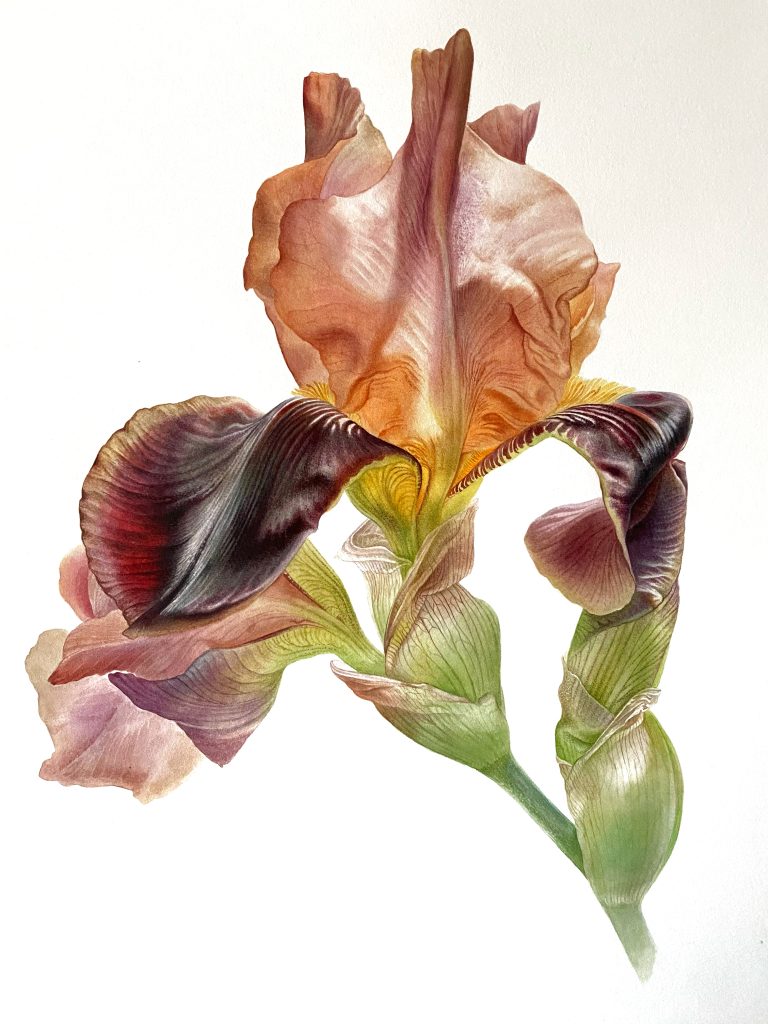
Iris by Svetlana Lanse
The moment when recognition becomes meaningful
Inessa: Your work is now included in some of the world’s most respected botanical art collections, including the Shirley Sherwood Collection and the Hunt Institute for Botanical Documentation. Looking back at your journey, was there a particular moment when you realised your artistic path had reached an important milestone?
Svetlana: It was actually very recently and surprisingly it was not about becoming part of collections.
It was about my workshop at Kew Gardens.
For me it was about trust. I am a passionate teacher and a passionate painter but when I realised that such a respected institution, with professionals who understand botanical art from the very beginning, trusted me to teach there, it was incredibly emotional.
I actually burst into tears with joy.
It was a very special moment and I immediately started preparing.
Inessa: I love that your most emotional milestone was connected not only with recognition but with sharing your knowledge. It says a lot about how important teaching is in your artistic life.
A painting can stay in a collection for generations but teaching allows an artist’s knowledge and passion to continue through other people.
Teaching botanical art with kindness
Inessa: You also have extensive experience teaching botanical art. What is the most valuable lesson you hope every student takes away from your classes?
Svetlana: It is funny, but I usually tell my students: “Blame the paper.”
In watercolour and botanical illustration there is often a strong desire for perfection. Sometimes something does not go in the direction we want and artists immediately blame themselves.
I tell my students: it is just paper — maybe the paper was damaged. Don’t blame yourself.
When people start blaming themselves for mistakes and small imperfections, it blocks their creative energy. I try to help them relax and enjoy the process, including the mistakes and imperfections.
I want to be a caring teacher.
Inessa: I think this is such a valuable message, not only for botanical artists but for anyone learning a creative skill.
The search for perfection can sometimes prevent us from enjoying the very process that brought us to art in the first place.
Knowing when a painting is finished
Inessa: Botanical artists often strive for accuracy and perfection. With so much attention given to detail, how do you decide when a painting is truly finished?
Svetlana: Oh my gosh — usually when it becomes muddy and I realise I cannot do anything more with it because I have already gone too far.
Many people around me, including my friends and my husband, tell me to stop a few layers earlier. But I always want to achieve more depth. I think: one more layer, then one more and then another one.
I usually overdo it!
Inessa: But when we look at your finished paintings, they don’t appear overworked. They look beautifully balanced and complete.
Svetlana: Maybe they look overdone to me because there is a big difference between looking at another artist’s work and looking at your own.
When you look at your own painting, you see everything — the struggle, the difficult moments and every layer that went into creating it. With another artist’s work, you only see the final result.
I really enjoy looking at other artists’ paintings without thinking about all the difficulties behind them.
Inessa: I think this is something many artists can relate to. We often judge our own work differently because we know every decision, every correction and every moment of uncertainty behind the finished piece.
Perhaps part of becoming an artist is learning when to step back and allow the painting to exist on its own.
The evolving world of botanical art
Inessa: Botanical art is becoming increasingly popular around the world. During your career what changes have you noticed and what excites you most about the future of botanical painting?
Svetlana: I have noticed that artists are constantly searching for greater perfection in technique, more interesting effects and new approaches.
Because of this, it has become much more difficult to stand out and create something that really catches people’s attention. Over the last ten years many extraordinary artworks have been created, with very special compositions and impressive colour effects.
Today, it is harder to surprise people.
But I like this challenge.
Inessa: I completely understand what you mean. The standard of botanical art today is incredibly high but perhaps this also pushes artists to look deeper and discover their own individual voice.
I remember standing in front of one of your works at an exhibition. At that time, I did not even know the plant but I was completely captivated by it. The light seemed to come from the flower itself.
For me that moment showed that botanical painting can become something more than scientific accuracy. It can reveal character, atmosphere and emotion.
Svetlana: Several times, American artists and lecturers contacted me about my earlier studies with light. I think I started exploring this direction with that painting.
They told me it was more than botanical accuracy and scientific illustration — it was about character.
I realised that I had achieved something meaningful and I wanted to explore it further. Now I am trying to go deeper and deeper in this direction.
Inessa: I think that is what makes an artist’s journey so exciting. The discovery of a personal language often happens gradually, through curiosity and experimentation.
Botanical art in the age of AI: why observation matters
Inessa: Today technology, including artificial intelligence and digital tools, is changing many creative fields. Do you think botanical art will change as well, or will careful observation from nature always remain at its heart?
Svetlana: I already see changes happening because of AI. Recently, I saw several botanical illustrations created by AI that contained botanical mistakes.
Of course, I think this is also a mistake by the human who created the prompt and did not check the result carefully. As AI develops and becomes more sophisticated, human observation from nature becomes even more important.
AI can be a wonderful tool but it needs to be controlled and used thoughtfully.
Inessa: I completely agree. For me the moment when an artist observes a real plant and develops a connection with it is something priceless.
When I watched you taking reference photographs before beginning your painting, I had the feeling that the creative process had already started. You were not simply recording information — you were studying the personality of the plant.
Svetlana: Yes, exactly. Sometimes after taking many photographs, I go to my computer and use Photoshop to combine different images into one composition.
But nowadays I try not to paint only from photographs. I prefer to have real models in my studio whenever possible.
Of course, I use photographs as a reference but I also keep the dried plant or the original subject nearby so I can look at it directly.
Sometimes I sit down to work on the composition and think, “Oh my gosh, I am already tired!” But then I remind myself that I need to paint it now while I still have that connection with the subject.
Inessa: This is such an important point. Technology can support the artistic process but the relationship between artist and nature cannot be replaced.
A botanical painting begins with seeing — not just looking but truly observing.
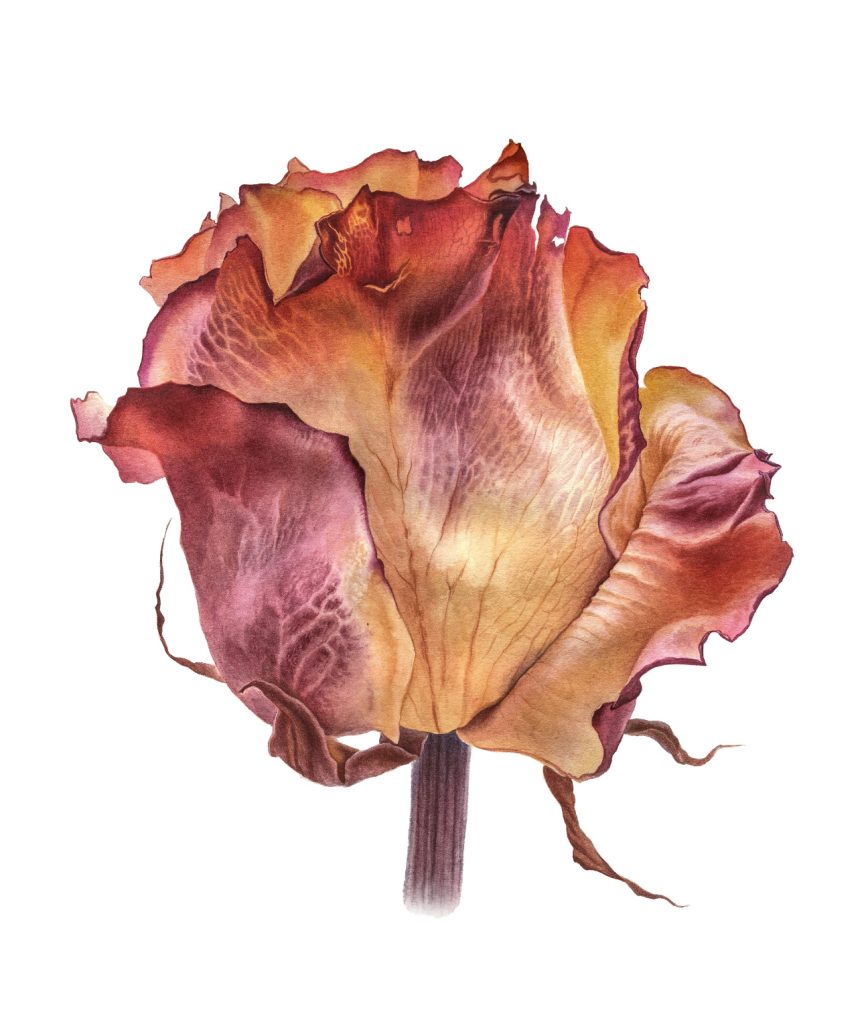
Beautiful age by Svetlana Lanse
Finding your own voice as a botanical artist
Inessa: Many artists dream of exhibiting internationally or having their work included in important botanical art collections. What advice would you give to an artist who hopes to achieve this?
Svetlana: Don’t be afraid to stand out.
My students often ask me questions like: “Can I do this? Can I show the plant this way? Can I cut it?” They are often nervous because they are thinking about all the rules.
But I think today, collectors are looking for something fresh and unique. Over many years, thousands of technically perfect botanical artworks have been created.
Sometimes people tell me that many paintings begin to look similar and it becomes difficult to recognise one artist from another.
Artists such as Fiona Strickland, Rory McEwen and Rosie Sanders developed their own unmistakable styles. I think this is the key.
It begins with choosing the right subject, observing it carefully and trying to show something personal — not simply copying from a photograph or a model.
Don’t be afraid to create something fresh.
Inessa: I love this advice because it connects with something I believe strongly too. Technique is essential but technique alone does not create a memorable artwork.
The artist’s own way of seeing is what makes a painting unique.
Svetlana: Exactly. Go forward and do it.
With my light technique I never asked anyone whether I was allowed to paint this way. I simply tried it and people surprisingly liked it.
Inessa: And you created something different. Sometimes the most interesting discoveries happen when artists trust their own curiosity.
Inspiration, artistic heroes and the plants that challenge us
Inessa: If you could spend a day painting alongside any botanical artist from history, who would you choose and why?
Svetlana: That is a very difficult question because I admire many botanical artists.
But I think I would choose Rory McEwen.
Last year, I visited his exhibition at the Garden Museum, learned more about his life and listened to his music. I would love to simply watch him work and understand his process.
His artworks are not only about botanical accuracy. They are about botanical portraiture — showing the personality and beauty of each plant.
Inessa: I completely agree. There is something very distinctive about Rory McEwen’s work. You immediately recognise his artistic voice.
This is something I find fascinating about the greatest botanical artists. Their paintings are accurate, but they also reveal something personal — a way of seeing the natural world that belongs only to them.
When a plant becomes a challenge
Inessa: Has there ever been a plant that completely defeated you? What happened and what did it teach you?
Svetlana: I have tried to paint hydrangeas many times.
I know other artists have painted them beautifully and I kept thinking, “I can do it. It is not that difficult.” But for some reason, my hydrangea paintings were never something special.
So now I try to avoid painting them!
Inessa: Maybe one day the right hydrangea will appear and inspire you again.
Perhaps a dried hydrangea?
Svetlana: Maybe!
But sometimes it is pointless to keep knocking on a closed door year after year. As artists, we have limited time, so we need to find our own way.
If something does not work the first time, try changing something. Find another approach.
Inessa: I think this is such wise advice. Artists often believe persistence means repeating the same attempt again and again but sometimes growth comes from changing direction.
Nature itself is constantly changing, and perhaps artists need to do the same.
The memory of light
Inessa: My final question is about your legacy as an artist.
When people look at your paintings, if they remember only one thing, what would you hope they remember or feel?
Svetlana: I think they will remember the light.
That is my goal. I try to bring light into every painting, and I really hope people remember that.
Inessa: I am sure they will.
Looking at your work, the light is not only something we see. It creates a feeling. It draws us closer to the plant and encourages us to look more carefully.
Thank you so much, Svetlana, for sharing your journey, your experiences and your thoughts with me. This conversation has been incredibly inspiring.
Svetlana: Thank you for this opportunity. I really enjoy talking about my art.
Inessa: I feel that I already knew your artworks but through this conversation I understand you more deeply as an artist. That is exactly why I wanted to create these conversations — to discover the person, the ideas and the stories behind botanical paintings.
I hope this is the first of many conversations.
Svetlana: Of course. I would be happy to continue.
Final thoughts from Inessa
Every artist has a different way of seeing.
Talking with Svetlana reminded me that botanical art is not only about creating an accurate representation of a plant. It is about attention, curiosity and the ability to reveal something that might otherwise remain unnoticed.
Svetlana’s paintings invite us to slow down and look closer. Through her extraordinary understanding of light, colour and character she transforms plants into portraits — each one with its own presence and story.
Perhaps the greatest lesson from this conversation is simple:
Before we paint nature, we must first learn how to truly see it.
About The Botanical Conversations
Hosted by Inessa Falina
Through The Botanical Conversations, I speak with botanical artists from around the world about their creative journeys, artistic discoveries and the unique ways they connect with nature.
These conversations explore not only how botanical art is created, but also the ideas, emotions and observations behind every painting.