Discovering the secret life of plants through botanical art and silverpoint
In The Botanical Conversations, I invite botanical artists to share the stories behind their work — their creative journeys, techniques, inspirations and the personal connections they develop with the natural world.
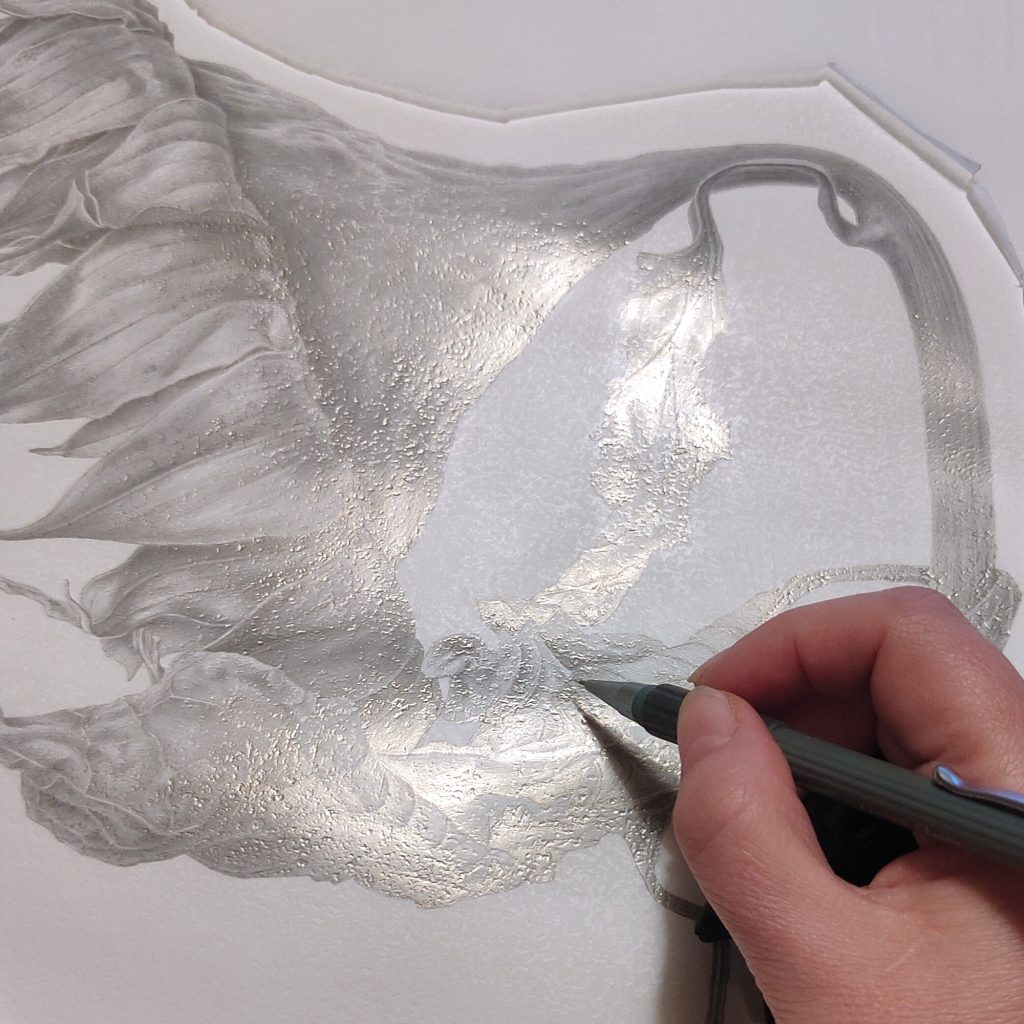
Silverpoint drawing process by Yuliia Moiseieva
For this conversation, I am delighted to introduce Yuliia Moiseieva, a Ukrainian botanical artist whose work combines close observation of nature with imagination, humour and storytelling.
I first came across Yuliia’s beautiful botanical artworks on Instagram several years ago. Her work immediately caught my attention, particularly the way she combined botanical observation with imagination, emotion and a distinctive sense of character. I decided to write to her.
That first message was the beginning of a friendship and an ongoing exchange of ideas about botanical art. Since then, we have had many conversations about our work, our approaches to nature and the things that inspire us. We have also had the pleasure of exhibiting together.
So this conversation is not my first encounter with Yuliia’s work. It is, in many ways, another chapter in a much longer botanical conversation.
What particularly fascinates me about Yuliia’s work is her ability to look at a plant and see more than its botanical structure. She searches for personality, mood and associations. A sunflower can appear almost human. A group of leaves can suggest a story. An ordinary botanical subject can suddenly make us wonder what we are really looking at.
Alongside watercolour, Yuliia has developed a particular passion for silverpoint, an ancient drawing technique in which an artist works directly with metal on a specially prepared surface.
Her journey into silverpoint is itself a wonderful story of curiosity and happy coincidence. After seeing unfamiliar tools in another artist’s work, she began investigating the technique. Around the same time, she had a batch of Arches paper that had proved unsuitable for watercolour. While researching silverpoint, she discovered that the very qualities that made the paper unsuitable for her original purpose could make it useful for drawing with metal.
What followed was not simply the discovery of a new medium but the beginning of an artistic exploration that continues today.
Yuliia experiments with different grounds, metals and tools, including specially prepared jewellery wire, mechanical pencils and, occasionally, rather unexpected objects such as rings and spoons.
She is also fascinated by something that makes silverpoint particularly unusual: the artwork continues to change after the artist has finished drawing.
Silver oxidises over time, gradually altering the appearance of the work. Yuliia describes the metal as becoming a “co-creator” of the artwork — an idea that says much about her broader approach to art, where curiosity and experimentation are as important as precision.
In our conversation, we talk about how she discovered botanical art, why she sees plants as personalities, the childhood memory that shaped the way she looks at the natural world, the unexpected story behind her move into silverpoint, the materials she uses and why she believes this ancient technique deserves to be rediscovered.
We also talk about humour, imagination, making art in Ukraine and the importance of allowing yourself to experiment without worrying about whether anyone else will see the result.
From an Instagram discovery to botanical art
Inessa: Yuliia, we have known each other for several years now and our friendship began rather simply. I discovered your work on Instagram, was fascinated by your botanical paintings and decided to write to you. Since then, we have had many conversations about botanical art and even had the opportunity to exhibit together.
Looking back, I realise that I knew your work before I knew the story behind it. So I would like to begin at the beginning.
When did botanical art become the language through which you wanted to express your connection with nature?
Yuliia: In 2019, I came across a free watercolour tutorial on Instagram. I tried it, then tried again and again. One day, someone left a comment on my drawing: “You’d be good at botanical art.”
That’s how I discovered the world of botanical illustration — a world where you don’t have to invent anything because nature has already decided everything for you.
Throughout 2020, during the coronavirus pandemic, I taught myself to draw, and in 2021 I took part in my first botanical art exhibition at SUBA.
Inessa: There is something lovely about the fact that your journey began almost by accident. You didn’t set out with a long-term plan to become a botanical artist. You tried a watercolour lesson, someone noticed something in your work and that small comment opened a completely new door.
And I particularly like what you say about not having to invent anything. In botanical art, nature gives us an extraordinary amount to work with — form, colour, texture, movement and structure. Yet, as your work shows, the artist can still find endless possibilities within what nature has already created.
Seeing the secret life of plants
Inessa: You often say that you explore the “secret life of plants”. What do you see in plants that other people might overlook?
Yuliia: I feel real joy when I manage to see a plant as a personality. I try to catch some kind of mood in its shape, colour and composition and to convey it on paper.
Sometimes it’s simply a character and sometimes it’s a whole story.
For example, I have a silverpoint piece called Sun-Dried, which won a SUBA silver medal in 2025. It shows an autumn sunflower with its head bowed under the weight of its seeds. What adds to the impression is the dry leaves placed beneath the seeds, as if to make sure not a single one is lost.
Inessa: I love this example because the botanical facts of the plant have not been changed at all, yet the way you arrange and observe them creates an entirely different experience.
The sunflower’s lowered head immediately suggests a character. It looks tired, perhaps even a little resigned, under the weight of its seeds. Then we notice the leaves beneath it and suddenly there is another suggestion — almost an act of care, as though they have been placed there to catch every seed.
This is where botanical art can become something wonderfully unexpected. We begin by looking at a plant. Then we start imagining who it might be.
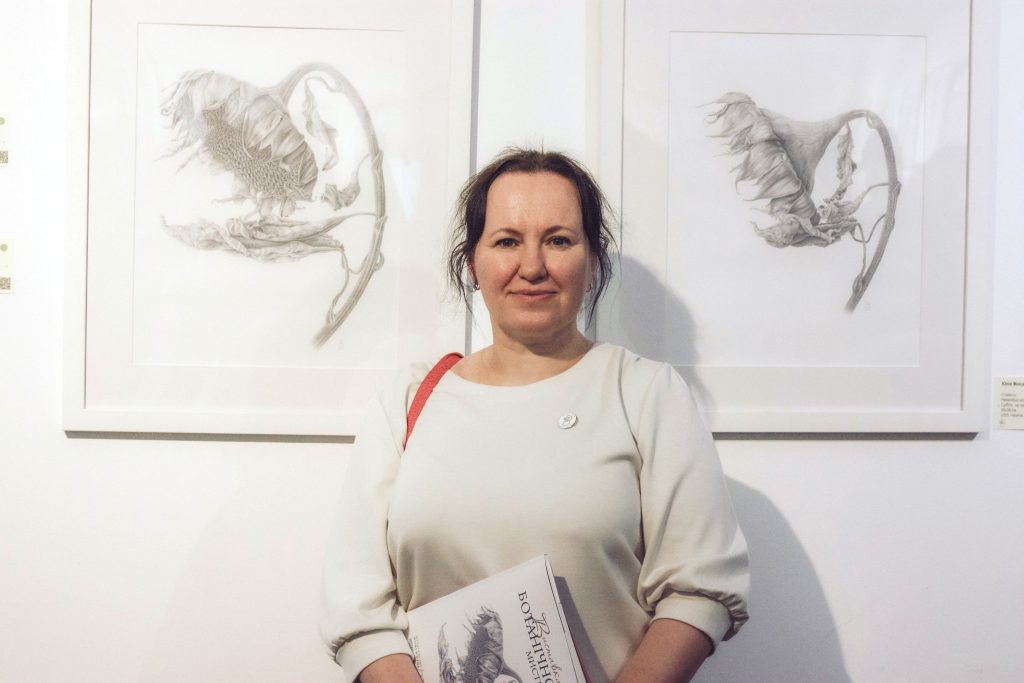
Yuliia Moiseieva and her beautiful Sunflowers in silverpoint
The childhood habit of looking for associations
Inessa: Many of your artworks transform simple botanical subjects into something with personality and emotion. An ordinary plant can become almost a character. How does this process begin in your imagination?
Yuliia: It’s like looking at a cloud and imagining what it resembles.
I remember that as a child, in winter, things were dried on a line inside the house and their shadow would fall on the wall. My father always used to ask what the shadow looked like.
Now, when I look at plants, I always find myself searching for what else they might resemble — other associations.
Inessa: I think this childhood memory tells us a great deal about the way you see. A shadow is simply a shadow, until someone asks: What does it look like? A cloud is simply a cloud, until suddenly we see an animal, a face or perhaps a landscape.
That habit of looking for associations seems to have stayed with you. It has simply moved from shadows and clouds to leaves, stems, flowers and seed pods.
And perhaps this is why imagination plays such an important role in your botanical work. You do not need to invent a plant. You only need to look at it long enough to discover what is already there.
The sheet of paper that failed — and opened a new door
Inessa: I remember when you received a sheet of Arches paper that unfortunately did not behave as expected for watercolour. Many artists would have returned it or simply put it aside. Instead, you discovered that it could be exactly what you needed for silverpoint.
Can you take us back to that moment? What made you look for a creative solution instead of seeing it simply as a failure?
Yuliia: It was more of a lucky coincidence.
When I saw the unusual tools in Angelina Cheong’s photographs, I couldn’t understand what I was looking at. It didn’t look like anything I’d seen before.
I started searching online to find out what this technique was, and the more I read, the more I wanted to try it.
Around that same time, I happened to have a batch of Arches paper that had turned out to be unsuitable for watercolour.
While studying silverpoint, I learned that not just any paper works for it — the surface affects how the metal oxidises.
So the paper that had failed for watercolour turned out to be exactly what I needed for this new technique.
Inessa: There is something wonderfully poetic about that coincidence.
The paper had not necessarily failed in itself. It had simply failed to do what you wanted it to do.
Once you changed the question, the material suddenly became useful.
Silverpoint also introduces a completely different relationship between the artist and the surface. Unlike graphite, which can be used on ordinary drawing paper, metal point requires a prepared surface that allows the metal to make a lasting mark.
And this is perhaps one of the recurring themes in your artistic journey: curiosity leads you somewhere, and then experimentation takes you further.
A problem becomes an experiment. The experiment becomes a discovery. And the discovery becomes part of your artistic language.
When something goes wrong
Inessa: Do you think some of the most important discoveries in art happen because something goes wrong? Has this experience changed the way you approach challenges in your artistic life?
Yuliia: I don’t feel that my core approach has changed much. In art, things rarely go exactly as planned from the start and that’s completely normal.
You just do what you can with what you have.
I’m also deeply inspired by other mediums. For instance, when I see charcoal drawings, I catch myself wishing I could adapt those techniques to silverpoint, so I experiment and try to craft my own tools.
I’m pretty sure all creative people operate this way.
Inessa: I think the phrase “do what you can with what you have” describes the creative process surprisingly well.
Artists often imagine that experimentation means deliberately setting out to invent something new. In reality, it can be much more ordinary.
You see something that interests you. You wonder if it could work in your medium. You try. It doesn’t work. You try again. And eventually you may discover a possibility that nobody had specifically planned.
I particularly like that Yuliia looks outside botanical art for inspiration. Charcoal becomes a source of ideas for silverpoint, and another artist’s tool can trigger an entirely new line of investigation.
Curiosity does not respect the boundaries between mediums.
Why silverpoint became irresistible
Inessa: What was the first thing that attracted you to silverpoint? Was it the technique itself, the history behind it or the unique feeling of drawing with metal?
Yuliia: I think it was mostly the process of drawing with metal itself, along with the idea that over time, the drawing will transform — the metal becomes a co-creator of the work.
I can only imagine how it will look in a year, two years or even longer.
Inessa: This idea of the metal becoming a co-creator is, for me, one of the most fascinating aspects of silverpoint.
When we think about a finished painting, we usually imagine that the artist has made all the important decisions. The work is completed and then preserved.
Silverpoint is different.
The artist makes the marks but the material continues its own process. Silver gradually oxidises and its appearance can become warmer and more muted with time. The artist therefore cannot know exactly what the drawing will look like many years later.
There is something almost philosophical about that. The artist creates the beginning of the work. Time continues the process.
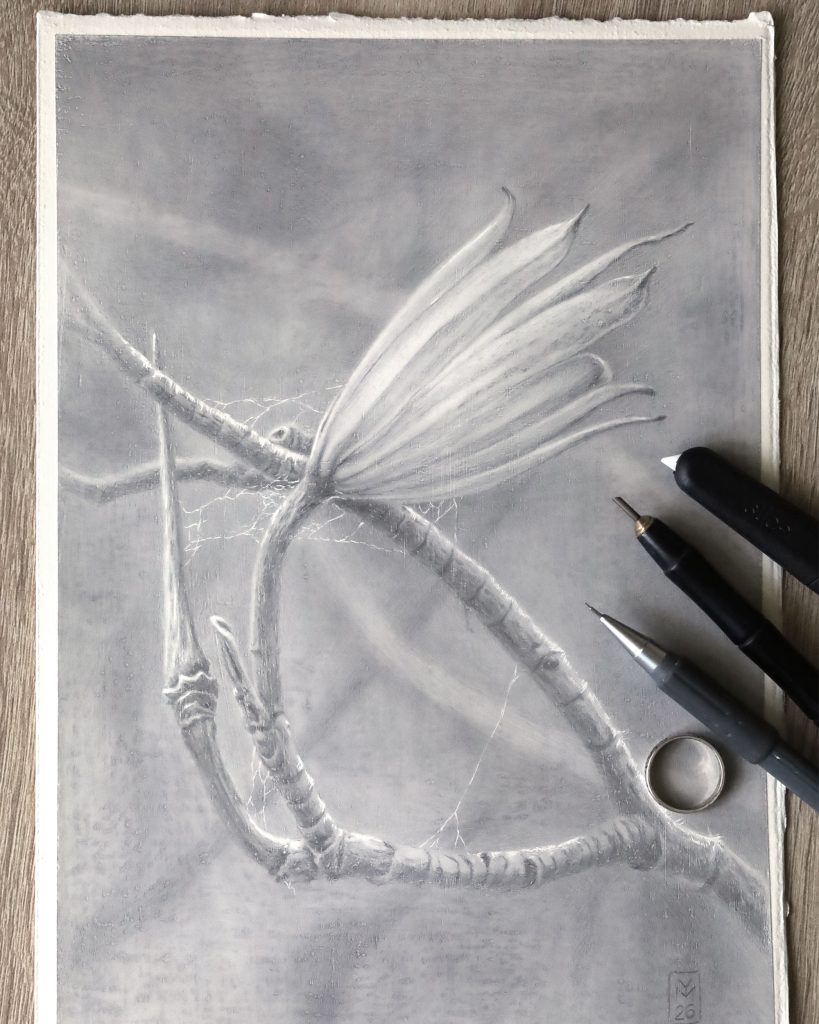
Silverpoint artwork by Yuliia Moiseieva
Watercolour and silverpoint: always wanting the other
Inessa: You are successful in both watercolour and silverpoint. How does your mindset change when you move from colour to a monochromatic medium?
Yuliia: When I paint in watercolour, I miss silverpoint and when I’m drawing in silverpoint, I feel drawn back to watercolour.
Lately, though, I’ve been favouring silverpoint more often because a monochromatic medium has one major advantage: it is much less demanding when it comes to lighting while working. You can draw even under a standard desk lamp.
Inessa: There is something very familiar to artists in this answer.
Perhaps the medium you are not using always looks particularly tempting.
Watercolour offers colour, transparency and the constant movement of pigment and water. Silverpoint removes much of that complexity and asks you to concentrate on line, tone, structure and the subtle behaviour of metal.
I also like the practical reason Yuliia gives for favouring silverpoint. Botanical artists spend a great deal of time thinking about light, especially when working with colour. A monochromatic technique offers a certain freedom from that.
Sometimes the simplest practical advantage can change how enjoyable a technique feels.
When slow drawing becomes relaxation
Inessa: Silverpoint requires precision and patience. What does this slow process teach you as an artist?
Yuliia: For me, silverpoint is more about relaxation than about learning a lesson.
Inessa: I think this is an important distinction.
We often talk about slow creative processes as though they must make us more disciplined, more patient or more productive.
But perhaps art does not always need to teach us something.
Sometimes it can simply give us a different rhythm.
For Yuliia, silverpoint seems to provide that slower space — a quiet process in which the act of drawing itself becomes the reward.
And that makes the technique surprisingly relevant beyond the world of botanical artists. You do not have to be interested in metalpoint to understand the pleasure of becoming completely absorbed in a slow creative activity.
Preparing the perfect surface
Inessa: Your silverpoint works have a very distinctive appearance. Could you share how you prepare your surface and what materials are essential for creating a successful silverpoint drawing?
Yuliia: Drawing with metal requires a specially prepared surface, so I test every option I can get my hands on — from gouache and watercolour grounds to dedicated silverpoint grounds and mineral paper.
Right now, I have two favourites: Golden acrylic ground and traditional Rublev ground.
For my pieces, I use cotton paper and apply several layers of ground. Once dry, I smooth the surface with sandpaper and then it’s ready for drawing with any metal.
I love working with silver because of how beautifully it oxidises into a warmer tone.
Gold doesn’t oxidise and stays grey. If you don’t know it was drawn with gold, it just looks like regular graphite.
Copper oxidises into a greenish hue, while aluminium stays black, but it smudges very easily, so I haven’t found a good use for it yet.
I mostly use special wire made of precious metal, which I insert into a mechanical pencil, but sometimes I use actual jewellery like rings or even spoons!
Inessa: The last part made me smile. There is something wonderfully inventive about a technique that can involve specialist jewellery wire one moment and a spoon the next. It also reminds us that although silverpoint has an ancient history, there is still plenty of room for experimentation.
The choice of metal, the surface and the way it is prepared can all change the
When botanical accuracy becomes imagination
Inessa: Your works are highly realistic but they also contain humour, emotion and storytelling. How important is it for you that botanical art goes beyond scientific accuracy?
Yuliia: I prefer incorporating humour into my work, and it brings me so much joy when I manage to convey a specific emotion, set a mood or tell a story.
I really want my art to spark the viewer’s imagination.
Inessa: This is perhaps the thread that connects everything we have discussed.
You began by saying that botanical art attracted you because nature has already decided everything for us. Yet you then take what nature has given you and invite the viewer to see it differently. That is a fascinating balance.
The plant remains botanically recognisable but it can also become funny, thoughtful, tired, curious or almost human.
For me, this is one of the pleasures of botanical art at its best. Scientific accuracy and imagination do not have to be opposites. One can make us look closely. The other can make us wonder.
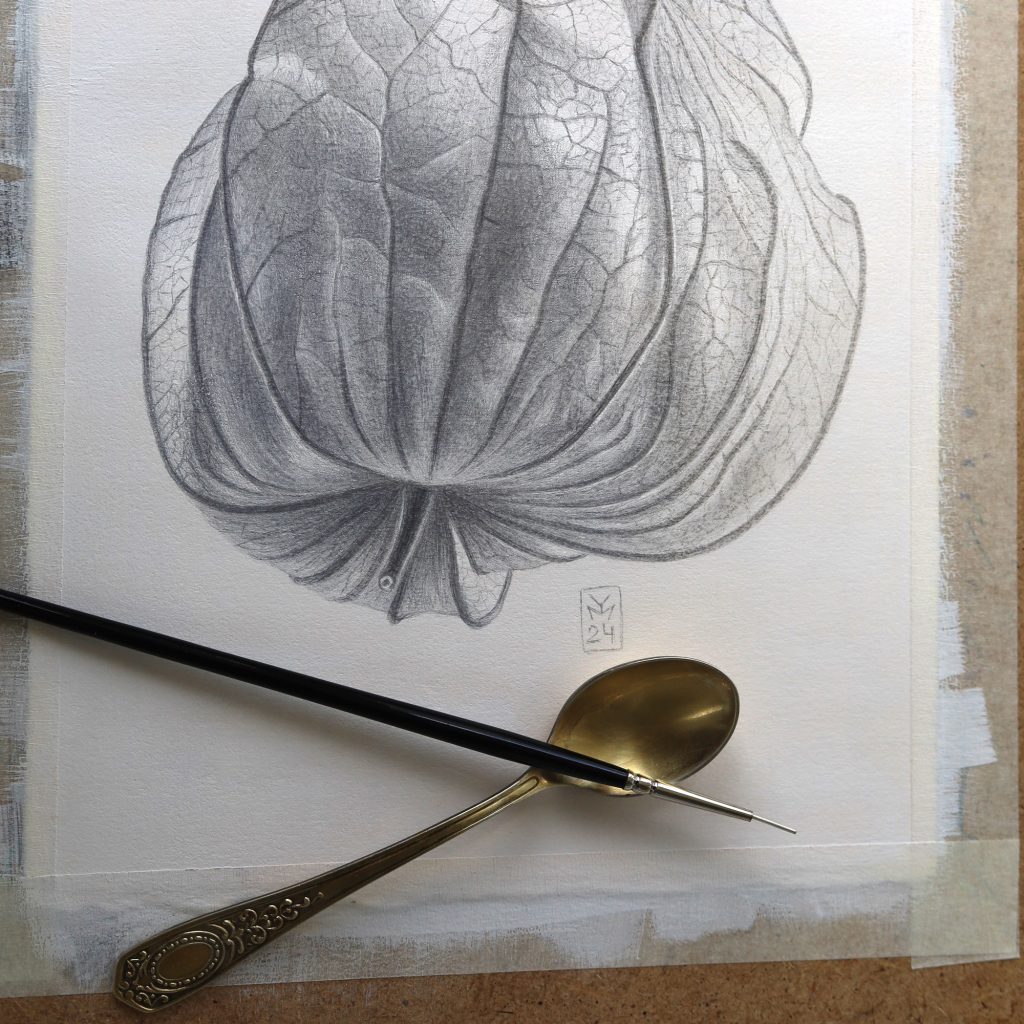
Silverpoint artwork by Yuliia Moiseieva and drawing tools
Rediscovering an ancient technique
Inessa: You now teach silverpoint. What inspired you to share this technique with other artists and what do you hope your students discover through it?
Yuliia: I teach a few live masterclasses a year.
Every time I discover a new technique or stumble upon something new — like a ground or a tool — I immediately want to share it and show it to other artists.
I feel that this ancient drawing technique is vastly underrated in the modern world and I’d love to help rediscover it. I believe it holds enormous potential.
Inessa: I think this is a natural extension of the way you work.
You are constantly experimenting, so your teaching is not simply about passing on a fixed recipe. It is about opening a door and encouraging other artists to investigate what might be possible.
Silverpoint has a long history, but that does not mean everything has already been discovered. New surfaces can be tested. Old techniques can be adapted. Unexpected tools can be explored.
And perhaps this is how an ancient technique becomes contemporary again — not by preserving it exactly as it was, but by allowing artists to continue questioning it.
When the artwork grows older
Inessa: Your silverpoint works have reached exhibitions and collectors internationally. Was there a particular moment when you realised that this technique had become an important part of your artistic identity?
Yuliia: I guess that silverpoint and I are still in the honeymoon phase!
I just want to show my works in this technique to as many people as possible.
The moment I pull a piece out of storage, it immediately begins to oxidise, and with every passing day, something subtly changes.
It’s like looking at yourself in the mirror — nothing seems different from yesterday, but a year later, looking at a photograph, a different person is staring back at you.
In the same way, metal artworks mature alongside the viewer.
Inessa: I think this is one of the most beautiful descriptions in our conversation.
The comparison with a photograph is particularly powerful. We do not notice ourselves changing from one day to the next, but look back after several years and the transformation is suddenly obvious.
Silverpoint has a similar relationship with time. The drawing is finished, but it is not entirely static. It ages. It develops. And if the artist and viewer return to it years later, they may both be looking at something subtly different from the work they first encountered.
Perhaps this is why Yuliia describes silver as a co-creator. The artist begins the work, but time has its own part to play.
Creating art in Ukraine
Inessa: You are an artist working in Ukraine. How has your environment and life experience influenced your creativity, your subjects or your way of seeing nature?
Yuliia: There are good days when inspiration comes easily and painting is a joy, and then there are days when you simply cannot draw at all after another missile strike or difficult news.
You feel an acute, sharp awareness of just how fragile life is.
Inessa: It is difficult to add much to such a simple statement.
What I find particularly moving is the honesty of it. There is no attempt to turn every experience into artistic inspiration.
Sometimes you can work. Sometimes you cannot. And sometimes the world outside the studio makes drawing feel completely impossible.
Yet perhaps this awareness of fragility also makes the act of observing nature more precious. A flower changes. A leaf dries. Silver oxidises. A drawing develops. Everything is temporary.
And perhaps being an artist means becoming especially aware of that constant movement.
A secret project nobody has to see
Inessa: For artists who are afraid to experiment or who feel disappointed when something does not work, what advice would you give them from your own experience?
Yuliia: When I’m afraid to experiment, I tell myself, “If it doesn’t work out, I just won’t show it to anyone — it’ll be my secret project.”
In that moment, the pressure disappears and you can just draw in peace.
If I’m disappointed with a piece I’ve made, I set it aside for a couple of months. Once my inner critic cools down, I can look at the artwork again with fresh, emotionless eyes and decide objectively whether it’s worthy of being shared with others.
And, of course, there’s that tried-and-true wisdom: don’t strive to create one ideal piece — just go ahead and make 10 of anything, and one of them will be great!
Inessa: I love the idea of the secret project. The moment nobody else has to see the result, the fear of failure becomes much smaller. You are no longer painting for an exhibition, a collector or another artist. You are simply experimenting.
And I think her advice about putting a disappointing work away is equally valuable. When we have just finished something, it can be almost impossible to see it objectively. A few months later, we may look at the same work differently. Perhaps the flaws will seem less important, or something we disliked will suddenly become interesting.
And then there is her final piece of advice: make ten. Not one perfect drawing, but ten attempts. It is a wonderfully practical antidote to perfectionism because it shifts the goal from getting it right to exploring what might happen
Looking again
Inessa: Yuliia, thank you for such thoughtful answers. You mentioned that some of my questions made you think about things you had not previously considered. I think that is one of the pleasures of a conversation like this.
Artists spend so much time making their work that they do not always have the opportunity to stop and ask themselves why they work in a particular way.
Talking to you has made me think about how closely your artistic process is connected to curiosity.
A free watercolour lesson led to botanical art. A comment from another person opened a new direction. A failed sheet of paper became the beginning of silverpoint. A photograph of an unfamiliar tool became a question. A childhood habit of seeing faces and shapes in shadows became a way of looking at plants. And a piece of silver becomes something that continues changing long after you have finished drawing.
Yuliia: Thank you for such thoughtful questions — some of them really made me reflect on things I hadn’t considered before.
It was a true honour to participate in this interview!
Final thoughts from Inessa
Final thoughts from Inessa
What stays with me most after speaking with Yuliia is the idea that seeing is an active process.
We often think botanical artists simply look more carefully than the rest of us. But Yuliia looks and then asks another question: What else does this shape resemble? What personality does this plant suggest? What could a different material or technique reveal?
That curiosity seems to sit at the centre of her work.
It is also what makes her approach to silverpoint so fascinating. At first glance, it appears to be a highly controlled and precise technique, yet beneath that precision is experimentation and uncertainty. The artist chooses the plant, prepares the surface and makes every mark. But then the metal begins its own journey. Time becomes part of the process.
Perhaps that is why Yuliia’s description of silver as a “co-creator” feels so appropriate.
Her work also reminds us that botanical art does not have to be confined to scientific observation. A plant can be accurately observed and still become a character. A botanical drawing can be precise and still make us smile. A seed pod can be both a botanical structure and the beginning of a story.
And perhaps the most encouraging part of Yuliia’s story is that none of this began with certainty. It began with trying something, then trying again and noticing something unexpected.
We do not always need to know where an experiment will lead. Sometimes it is enough to make the first mark and remain curious about what happens next.
After all, the sheet of paper that failed as watercolour paper did not become useless.
It simply had another story waiting for it.
About The Botanical Conversations
Hosted by Inessa Falina
Through The Botanical Conversations, I speak with botanical artists from around the world about their creative journeys, artistic discoveries and the unique ways they connect with nature.
These conversations explore not only how botanical art is created but also the ideas, emotions and observations behind every painting.
Because behind every botanical artwork there is a person who looked at nature and saw something worth sharing.
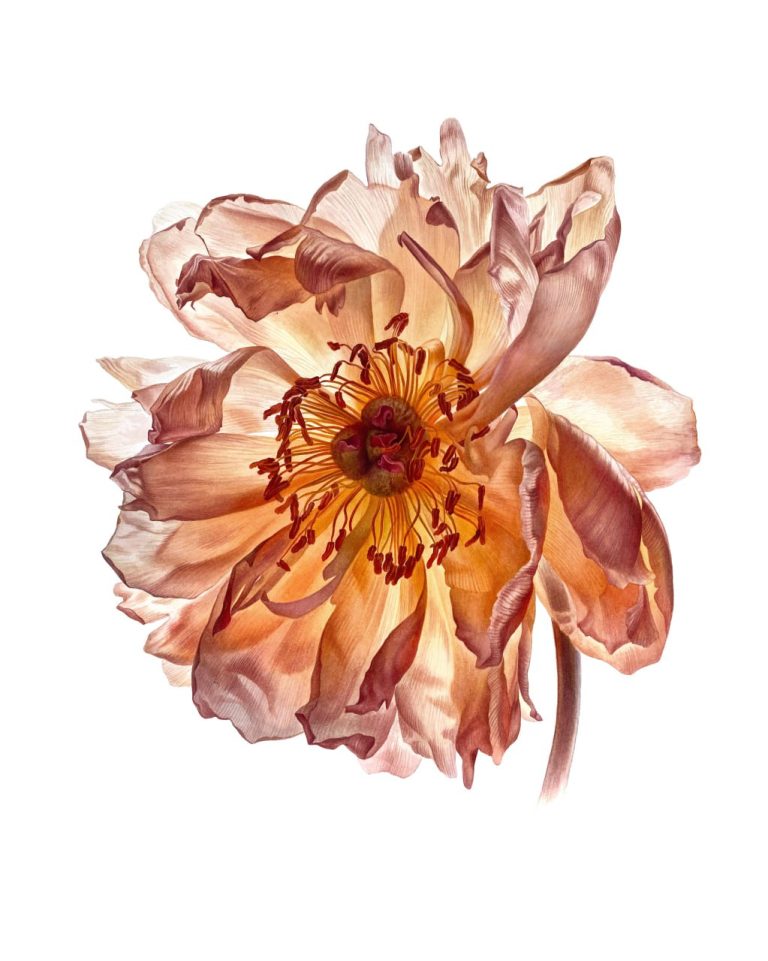
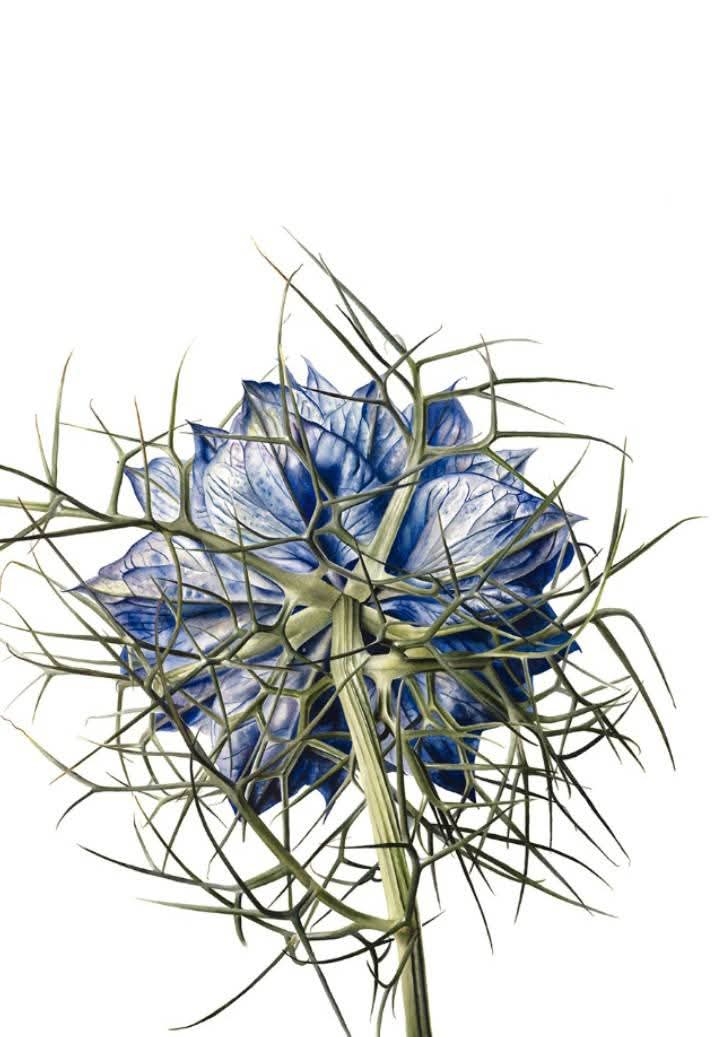
Inessa, thank you for the interview! Your observation of my creative journey came as a surprise to me. I’d never thought about it that way, never traced that chain: a free watercolour tutorial — botanical painting, a child’s perception of shadows — the concept behind my work, a photo of an unfamiliar tool — the silverpoint technique. You noticed something I hadn’t noticed myself. Thank you again for such a thoughtful and warm conversation!