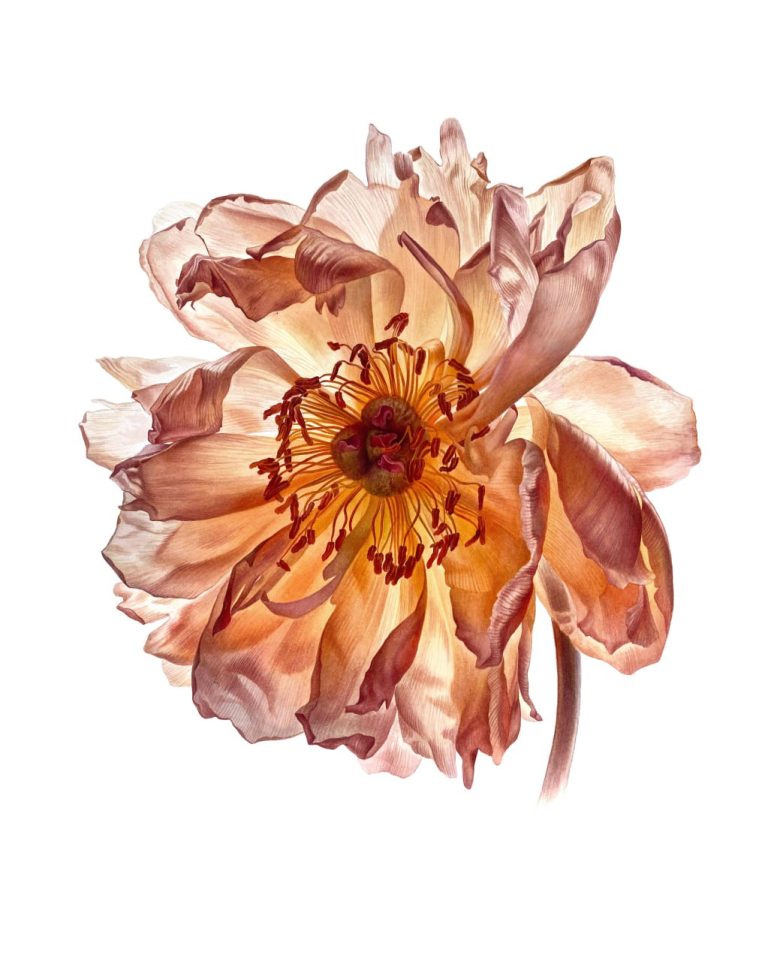
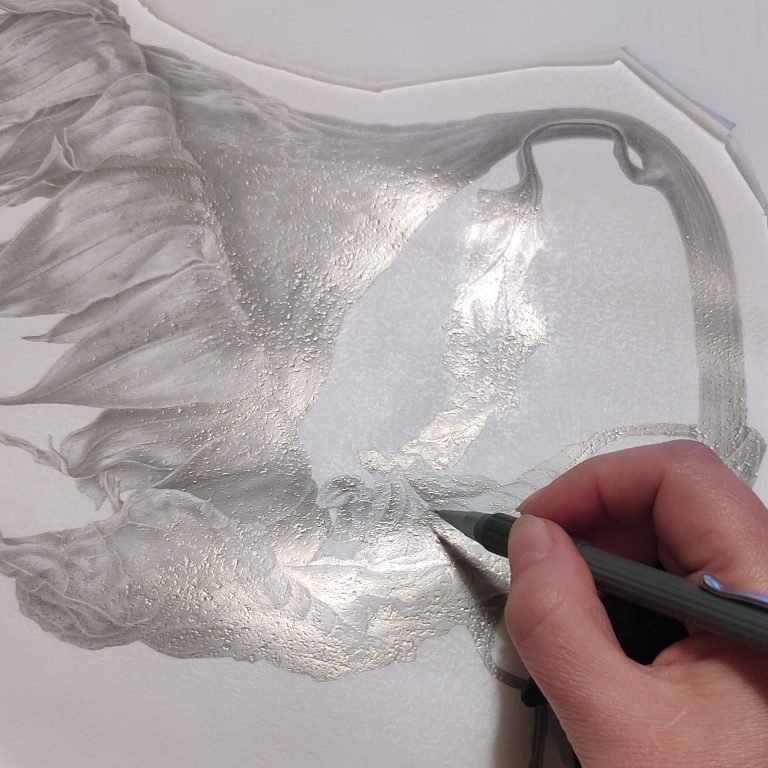
From a childhood spent exploring nature to Blaue Blume, Úrsula Romero’s artistic journey explores how plants can become a language for emotion, identity and belonging.
In The Botanical Conversations, I invite botanical artists to share the stories behind their work — their creative journeys, techniques, inspirations and personal connections with the natural world.
For this conversation, I am delighted to introduce Úrsula Romero, an artist whose work has evolved from scientific botanical illustration towards a more personal and emotionally charged exploration of plants. Her artistic journey raises fascinating questions about what botanical art can be, how it can make us feel and why representing a plant accurately may sometimes be only the beginning.
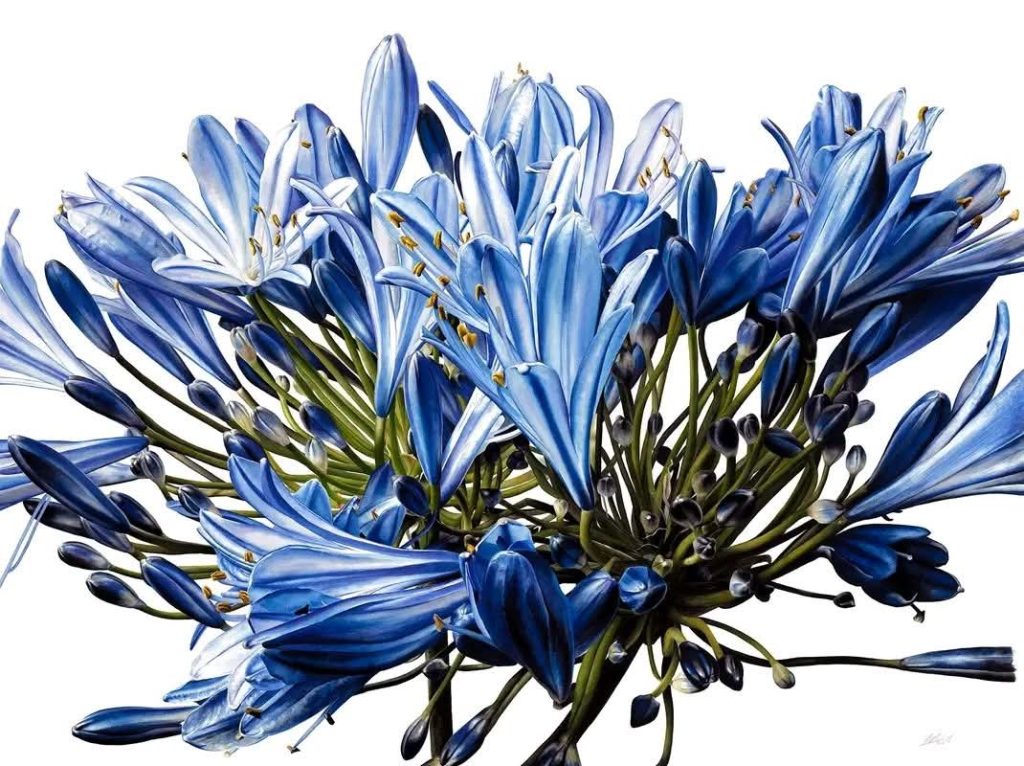
The Kiss by Úrsula Romero
Úrsula’s relationship with the natural world began in childhood. Her father, a keen gardener and enthusiastic naturalist, taught her to observe plants, birds, insects and amphibians. Their walks in the countryside and time spent in his garden gave her an early understanding of the relationships between plants, their environments and the wider natural world.
Her interest in drawing flowers began when she was around seventeen, following her father’s retirement and his decision to take on an allotment. This was the beginning of Inky Leaves, the business she has continued to develop over the past 24 years.
Yet her artistic ambitions began much earlier. At seven, while visiting the Greek island of Paxos, she painted a large, bowl-shaped pot surrounded by geraniums and succulents. She remembers being impressed by the result and, just as importantly, enjoying the entire process. Even then, she knew she wanted to become a painter.
Her studies in botany gave her a technical foundation, but Úrsula’s artistic curiosity has always extended beyond scientific representation. She became interested in the emotional response a painting could create and how art might help us overcome what is known as plant blindness — our tendency to overlook plants and fail to notice their importance in the world around us.
A defining moment came in 2012–2013, when she helped hang the Rory McEwen exhibition at Kew Gardens. Seeing the extraordinary quantity and quality of his work, alongside David Hockney’s The Bigger Picture exhibition at the Royal Academy, made her realise that becoming a professional artist would require a fundamental change in her life. She decided to leave her nine-to-five job and devote more time to painting.
Later, meeting contemporary artist Nick Fudge introduced her to new ways of thinking about art history and the importance of continuing a conversation that began with artists of earlier generations. The work of artists such as Edward Ruscha and Giorgio de Chirico continues to inform her thinking.
Her own work has since moved beyond watercolour into oil painting, allowing her to explore scale, negative space and depth in new ways.
Her latest book, Blaue Blume, takes its inspiration from the work of German Romantic writer Novalis. Through this collection, Úrsula explores our relationship with the natural world, the geographical movement of plants and the human search for belonging. Beneath the beauty of her botanical subjects, there is often something unsettling: a detail that feels slightly out of place, revealing the complex and sometimes dystopian world we have created.
I was particularly interested in speaking with Úrsula because her journey challenges some of the expectations we may have about botanical art. What happens when scientific accuracy is no longer the only objective? Can a flower become a way of telling a personal story? And how can art encourage us to notice the natural world more deeply?
In our conversation, we explore the experiences that shaped her artistic identity, the freedom of developing a personal voice, the transition from watercolour to oil and the ideas behind Blaue Blume.
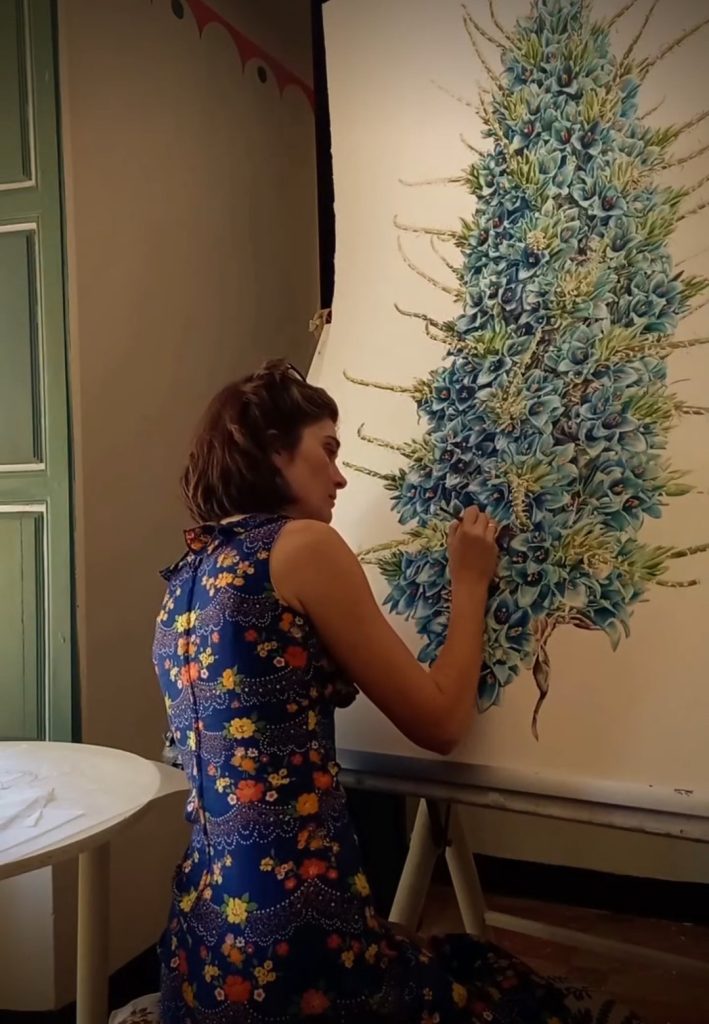
Úrsula Romero in her studio at Casa de la Morera
A childhood shaped by the natural world
Inessa: Úrsula, what first drew you towards plants and the natural world?
Úrsula: My father was a monumental influence on me. He taught me from birth how to respect the natural world and how it all works. We would go birdwatching frequently, and he was a keen gardener. I spent most of my childhood either in his garden or in the countryside on walks with him.
He taught me the names of plants and how they grow, what different plants prefer in terms of environments and where in the world they came from. He also taught me about insects and amphibians.
When he retired, he got an allotment. I was around seventeen at the time, and that was when I started drawing flowers in ink — hence the name Inky Leaves. That is how long Inky Leaves has been running.
Inessa: I find it lovely that your relationship with plants began through such close contact with nature and through your father’s enthusiasm for sharing what he knew.
There is something important about learning to recognise plants in their natural surroundings, understanding where they grow and what they need. It gives you a way of looking at the natural world that goes beyond appearance.
Your father’s influence seems to have provided not only botanical knowledge but also the curiosity that continues to run through your work today.
The moment art became a possibility
Inessa: When did you first realise that art was going to become an important part of your life?
Úrsula: I was seven years old, taking a holiday on a Greek island called Paxos, where my mother’s sister lives.
I did a watercolour painting of one of those giant pots you see over there. Not an amphora — this was wider and more bowl-shaped — and it had these beautiful geraniums growing around it, along with succulents.
I remember being very impressed by what I painted, and I remember enjoying the entire process. I thought then: I want to become a painter one day.
Inessa: It is fascinating how clearly we can sometimes remember an early creative experience. At seven, you already had that combination of pleasure in the process and excitement about what you had created.
I wonder how many artists can trace their ambitions back to a particular moment like this. Sometimes the desire to make art is there long before we have the experience or knowledge to understand where it might lead.
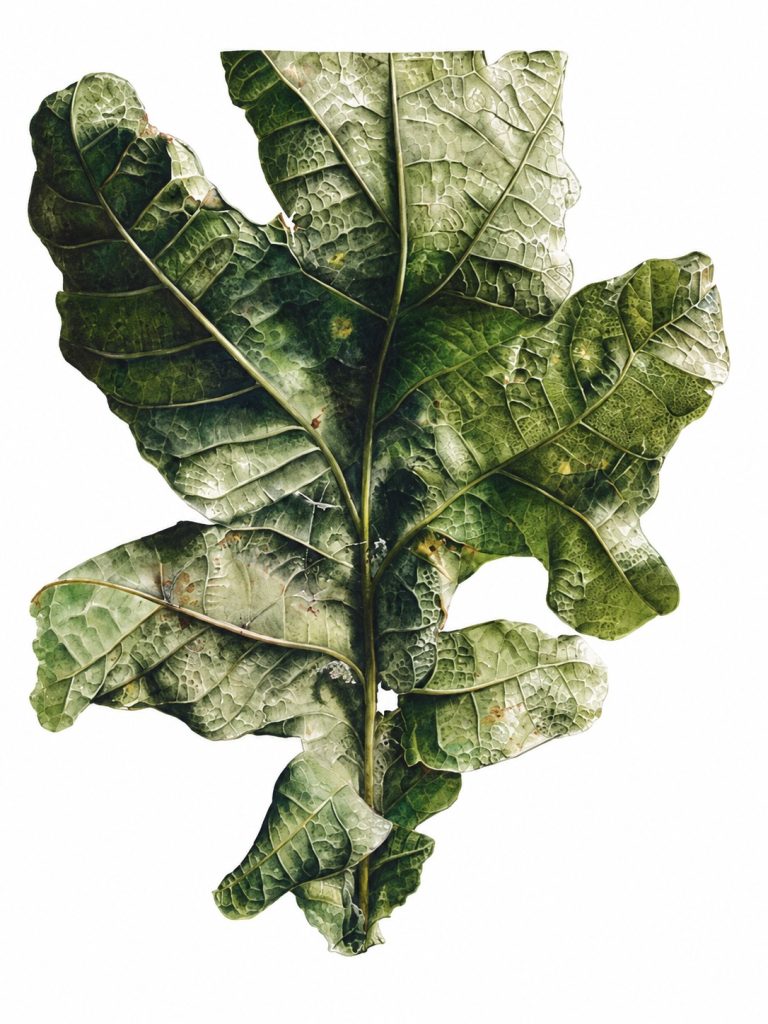
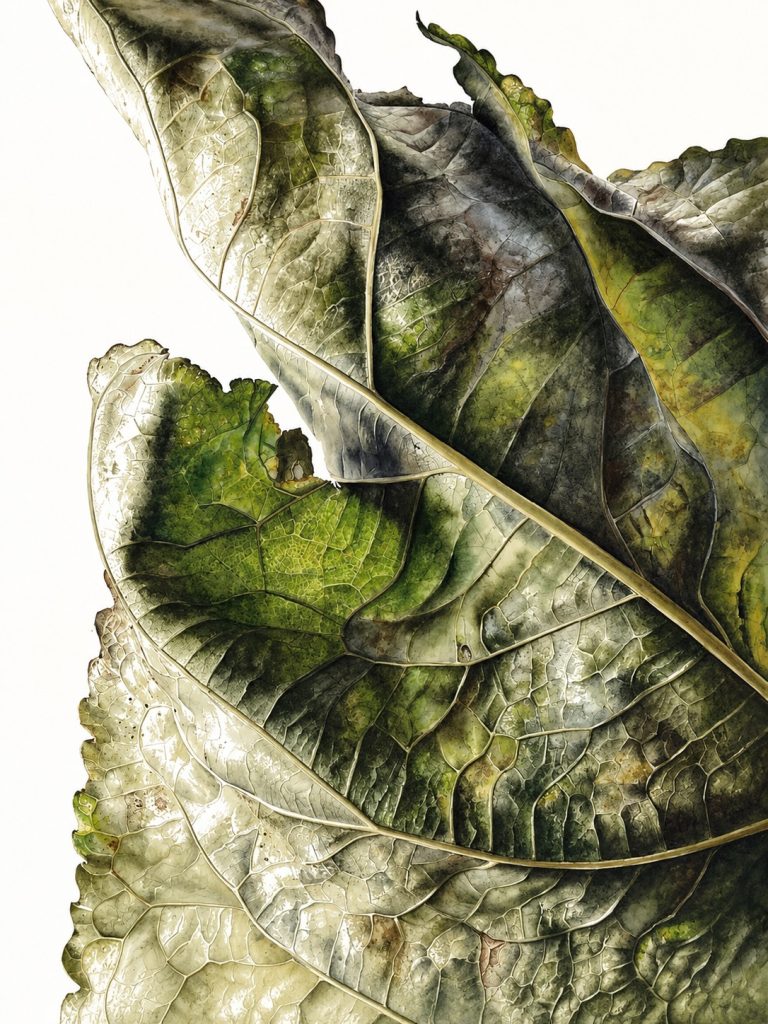
Leafscape by Úrsula Romero
From botanical science to artistic expression
Inessa: How did your background in botany influence the way you see and understand plants?
Úrsula: I think my studies in botany have helped immensely. They gave me a technical foundation from which to experiment. My early work was mostly scientific.
Inessa: That technical foundation seems particularly relevant to the direction your work has taken. Understanding the structure of a plant and the way it grows gives you a starting point from which to explore it more freely.
I am interested in the relationship between botanical knowledge and artistic expression. Scientific understanding can help us see a plant more clearly, but an artist can also use that understanding to ask different questions about what a plant represents and how we respond to it.
Inessa: What first attracted you to botanical art?
Úrsula: To be honest, I don’t really know. I guess I found it beautiful and elegant, and I was intrigued by its symbology as well as its scientific value.
Inessa: I like your honesty here. Not every artistic decision begins with a clearly defined reason. Sometimes we are drawn to something because of its beauty, and only later begin to understand the different ideas and possibilities it contains.
Botanical art offers an intriguing meeting point between observation, science and symbolism. A plant can be studied as a living organism, appreciated for its form and colour or used to communicate something that has little to do with its botanical identity alone.
Finding an artistic voice
Inessa: You are largely self-taught as an artist. What was the most challenging part of finding your own artistic voice?
Úrsula: The challenges are mostly about running a business as an artist rather than finding my voice. My voice has always been around like a loyal dog. It isn’t challenging to find my voice; it’s part of me. I am happy to go to the depths, and I enjoy who I am.
Inessa: I love your description of your artistic voice as a loyal dog that has always been there. It feels so true that sometimes we don’t need to search for our voice, but simply trust it and give it space to grow. I also understand what you mean about the challenges of running an art business. Finding time to paint while managing everything else is not always easy!
The exhibitions and artists that changed everything
Inessa: Was there a particular artist or experience that changed the direction of your artistic journey?
Úrsula: I would say that hanging the Rory McEwen show at Kew Gardens in 2012–2013 was a big game changer. It was this that made me decide to quit my job and have a go at becoming a full-time professional artist.
Something about the sheer quantity of work alongside the quality made me realise that I needed to create more time in my schedule to paint. That meant ditching the nine-to-five job.
That same year, David Hockney had his show The Bigger Picture on at the Royal Academy. Again, this spurred me on. I was fascinated by the way he used vanishing points to curate an immersive exhibition. I realised that this sort of genius only happens when you dedicate your life to your craft. I needed to focus.
In 2019, I met YBA Nick Fudge. This was another pivotal point in my career. He taught me the history of art and the importance of continuing the conversation from artists past. He introduced me to the works of de Chirico and Edward Ruscha, among many others. Ruscha’s influence was interpreted in my Blue Flower Collection with the Nipped in the Budseries. De Chirico is still having an influence.
Inessa: What strikes me about these experiences is that each one seems to have opened up a different possibility.
Rory McEwen’s exhibition helped you recognise the commitment required to develop a serious body of work. Hockney’s exhibition showed you how the presentation of art could transform the experience of viewing it. Later, your conversations with Nick Fudge expanded your understanding of art history and the connections between artists across generations.
These are different kinds of inspiration, but they share an important theme: the realisation that art is not simply about producing individual paintings. It is also about developing ideas, dedicating time to them and understanding how your work relates to a much wider artistic conversation.
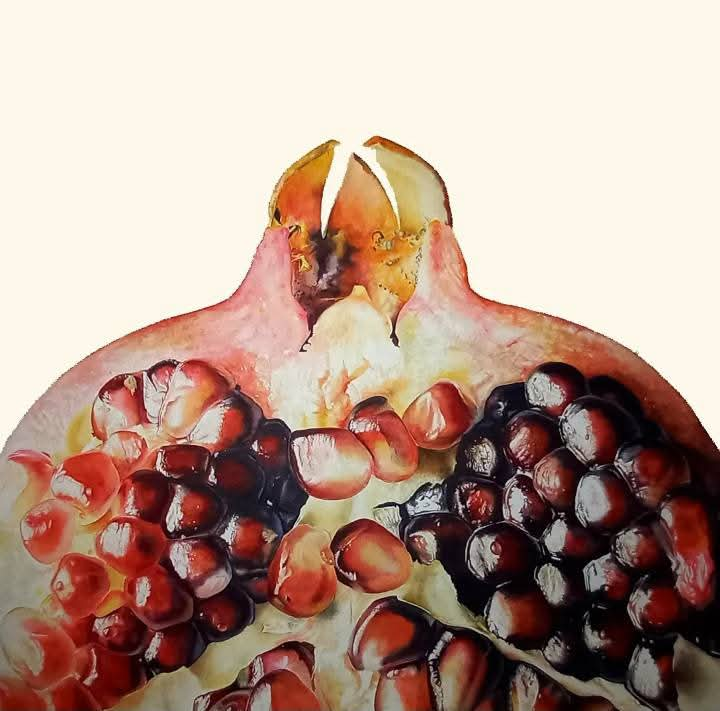
Pomegranate by Úrsula Romero
When botanical representation is no longer enough
Inessa: When did you begin to feel that traditional botanical representation was no longer enough for you?
Úrsula: I think this happened fairly early on. There’s a blog post I wrote about creating a felt reaction in painting and how I felt this was important.
Back in 2012, I applied for a PhD to study this. I didn’t do the PhD because of a lack of grants, but it has always been an interesting talking point for me. The basis of creating an emotional reaction was to find a way of curing plant blindness.
Inessa: I find this idea particularly compelling because it asks us to consider what botanical art can achieve beyond accurate representation.
We can look at a plant, recognise its structure and appreciate the skill involved in depicting it. But does that necessarily mean we have really noticed it? Have we felt any connection with it or considered its place in the world?
Your interest in creating an emotional response suggests that art can be a way of bringing plants into our awareness. Rather than simply presenting a subject for us to identify, a painting can encourage us to pause, look again and perhaps feel something we had not expected.
The idea of addressing plant blindness through an emotional response also connects scientific observation with a more personal experience of nature. It is not only about seeing a plant but about making it matter to the person looking at it.
Plants as a way of telling personal stories
Inessa: You have described your plants as a way of telling your own story. What stories do they allow you to express?
Úrsula: I’m not sure how to answer this. The stories change. The paintings are autobiographical.
Inessa: Perhaps the fact that the stories change is part of the point. If your paintings are autobiographical, each one can reflect a particular moment, thought or experience without needing to tell a fixed story.
I am intrigued by the idea of using plants in this way. Flowers and leaves have their own forms, histories and associations, but they can also become a language through which an artist explores personal experiences.
The botanical subject remains present, yet the painting can hold meanings that are not immediately visible. It invites us to look beyond what is represented and consider what might lie beneath the surface.
Knowing when it is time to change direction
Inessa: Your work has evolved considerably over the years. What usually tells you that it is time to move in a new artistic direction?
Úrsula: Inspirational thought.
Inessa: A wonderfully concise answer. It suggests that change begins with an idea rather than with a decision to change for its own sake.
Looking at your journey, there have been several moments when a new influence or an emerging question has led you towards a different way of working. Your curiosity about emotional responses in painting, your encounters with other artists and your interest in art history have all contributed to this evolution.
Perhaps the important thing is to remain receptive to ideas when they appear, even when they lead somewhere unexpected.
From Inky Leaves to Úrsula Romero
Inessa: What inspired your transformation from Inky Leaves into Úrsula Romero?
Úrsula: I was never Inky Leaves! Inky Leaves is my company brand, not my name. I went from Jessica to Úrsula. This was mostly for personal reasons, but also to separate my private life from my public one. Inky Leaves still runs strong. I’ve had the company for 24 years.
Inessa: Thank you for clarifying this distinction. It is interesting to learn how the different parts of your identity have developed alongside your artistic career.
A business name can become closely associated with an artist’s work, yet it does not necessarily tell us everything about the person behind it. In your case, Inky Leaves remains an established part of your professional life, while the name Úrsula reflects a separate personal journey.
It is a reminder that an artist’s public identity is not always a straightforward reflection of their private life.
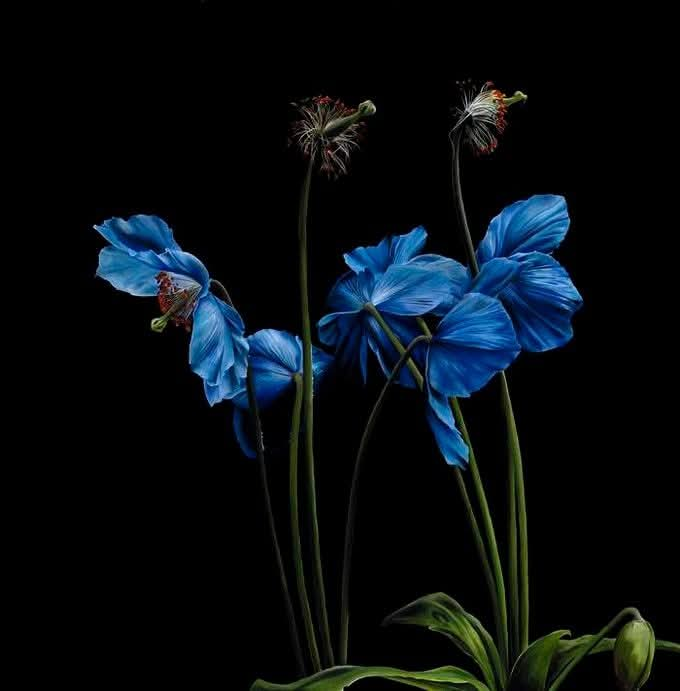
Meconopsis sp. by Úrsula Romero
What oil painting made possible
Inessa: What did moving from watercolour into oil painting open up for you creatively?
Úrsula: Lots. It meant I could work at a bigger scale. It meant I could work with negative space, create depth and work faster.
Inessa: It’s lovely to hear how moving to oil painting opened up new possibilities for you. I can imagine how exciting it must be to work on a larger scale and explore depth and space in new ways, creating a different experience for the viewer.Blaue Blume: nature, geography and belonging
Inessa: Your latest book brings together your knowledge, experience and artistic journey. What inspired you to create it, and what would you most like readers to take away from it?
Úrsula: My latest book, Blaue Blume, was inspired by the book of the same title by Novalis. His book sparked the Romantic Movement, a time when people seemed to place more value on the natural world, its flora and fauna. I wanted to create something that would recreate this.
This is a continuation of my work on healing plant blindness — giving the flowers a stage so we can see them more clearly. Placing value on the plant.
However, this collection also documents the geographical complexity of the world we have made. Flowers from Chile are found in Australia in botanical zoos, for example.
There is always something dystopian or eerily incorrect in my works. It’s in the details.
Leafscape was a book about geography and time. Blaue Blume is certainly more about geography and the search for belonging.
Inessa: Your description of Blaue Blume brings together several of the ideas we have discussed: the value we place on plants, the emotional response a painting can create and the relationship between the natural world and the world shaped by human activity.
I am particularly interested in your observation that something can appear beautiful while also feeling slightly wrong. The flowers may be visually compelling, but the details can prompt us to question the circumstances in which we encounter them.
A plant growing far from its geographical origins can tell a story about movement, collecting and the ways humans have reshaped the distribution of species. Your paintings seem to hold this complexity rather than offering a simple answer.
The connection with Novalis and Romanticism also introduces another dimension. At a time when the natural world was becoming a powerful source of artistic and philosophical inspiration, plants could represent much more than their physical appearance. They could suggest longing, imagination and the search for something beyond the immediately visible.
In Blaue Blume, these ideas meet the realities of our contemporary world. The flowers are given a stage, as you describe it, but they also become part of a wider reflection on geography and belonging.
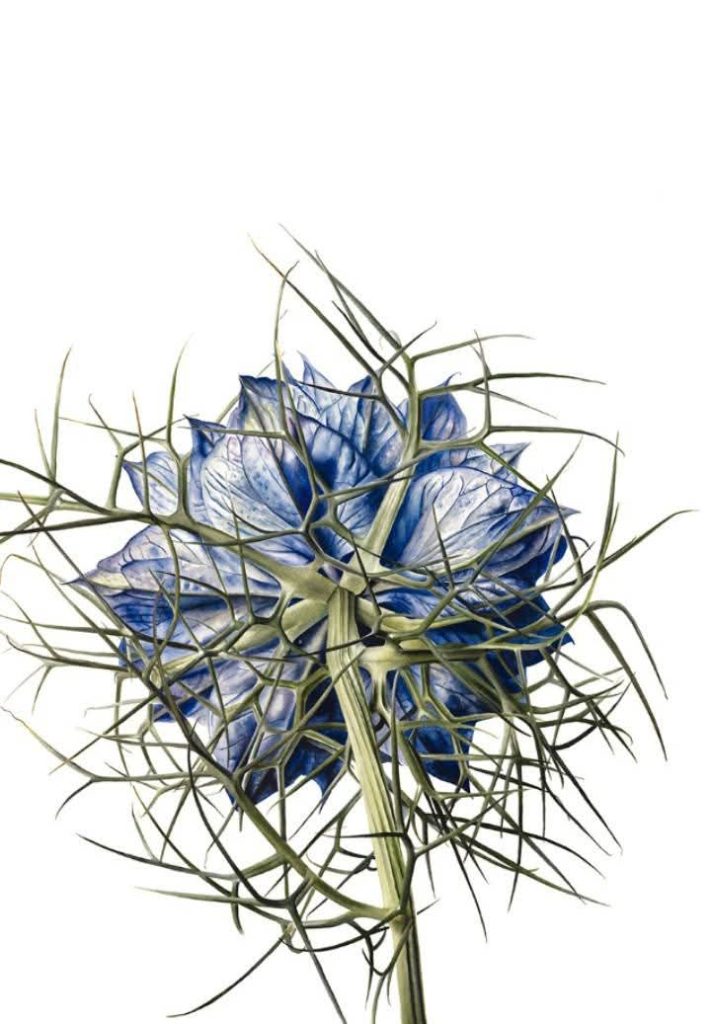
Nigela Damascene by Úrsula Romero
Trusting the unfolding of a creative life
Inessa: Looking back at your journey so far, what have you learned about yourself as an artist that you wish you had known when you began?
Úrsula: There isn’t anything. I generally don’t regret things. I trust in the timing of unfolding flowers.
Inessa: I love this final thought because it brings us back to the natural world that has been part of your life since childhood.
There is a quiet confidence in your answer. Rather than looking back and wishing you had known more or made different decisions, you seem comfortable with the way your journey has unfolded.
Flowers develop in their own time, and perhaps an artistic life does too. There are periods of learning, moments of change and ideas that need years to find their expression. Not everything can be hurried, and not every stage needs to be understood while we are living through it.
Your journey has included scientific study, a decision to leave a conventional career, encounters with artists who changed your thinking and a willingness to move beyond established ways of representing plants. Through it all, you have continued to follow your curiosity.
Perhaps that is what makes an artistic journey so interesting: we cannot always know what the next stage will bring, but we can remain open to the possibility that something new is waiting to unfold.
Final thoughts from Inessa
Talking with Úrsula has made me think about the many different roles botanical art can play.
It can record the structure of a plant with scientific precision. It can celebrate the beauty and elegance of flowers. It can encourage us to notice species we might otherwise overlook. And it can become a way for an artist to explore personal experiences, questions about the world and the search for belonging.
Úrsula’s work brings these possibilities together in a distinctive way. Her botanical knowledge provides a foundation, but her artistic ambitions reach beyond representation. She wants the flowers to hold our attention, to create a response and to make us think about the natural world in a different way.
I was particularly struck by her determination to move beyond traditional botanical illustration and her belief in creating an emotional connection with the viewer. It is a reminder that looking carefully at nature is only the beginning. What we notice can change how we feel, and how we feel can change what we value.
Her story also offers a different perspective on artistic development. Sometimes a change of direction begins with an exhibition, a conversation or an idea that refuses to go away. Sometimes it requires a practical decision, such as leaving a job to make more time for painting. And sometimes it simply means trusting the process rather than regretting what came before.
Úrsula’s final words stay with me: “I trust in the timing of unfolding flowers.”
Perhaps there is something in this for all of us, whether we are artists or simply people who want to bring more creativity into our lives. We do not always need to know what comes next. Sometimes we need to give ourselves the time and space to discover it.
About The Botanical Conversations
Hosted by Inessa Falina
Through The Botanical Conversations, I speak with botanical artists from around the world about their creative journeys, artistic discoveries and the unique ways they connect with nature.
These conversations explore not only how botanical art is created but also the ideas, emotions and observations behind every painting.
Because behind every botanical artwork there is an artist with a particular way of seeing the natural world — and a story worth discovering.
About Úrsula Romero
Úrsula Romero is an artist whose work explores the relationship between botanical representation, emotion and personal storytelling. With a background in botany, her artistic practice has evolved from predominantly scientific work towards a more expressive approach to plants and the natural world.
She is the founder of Inky Leaves, a business she has run for 24 years. Her work includes the Blue Flower Collection and the Nipped in the Bud series. Her books include Leafscape and Blaue Blume, the latter exploring the geographical complexity of the natural world and the human search for belonging.