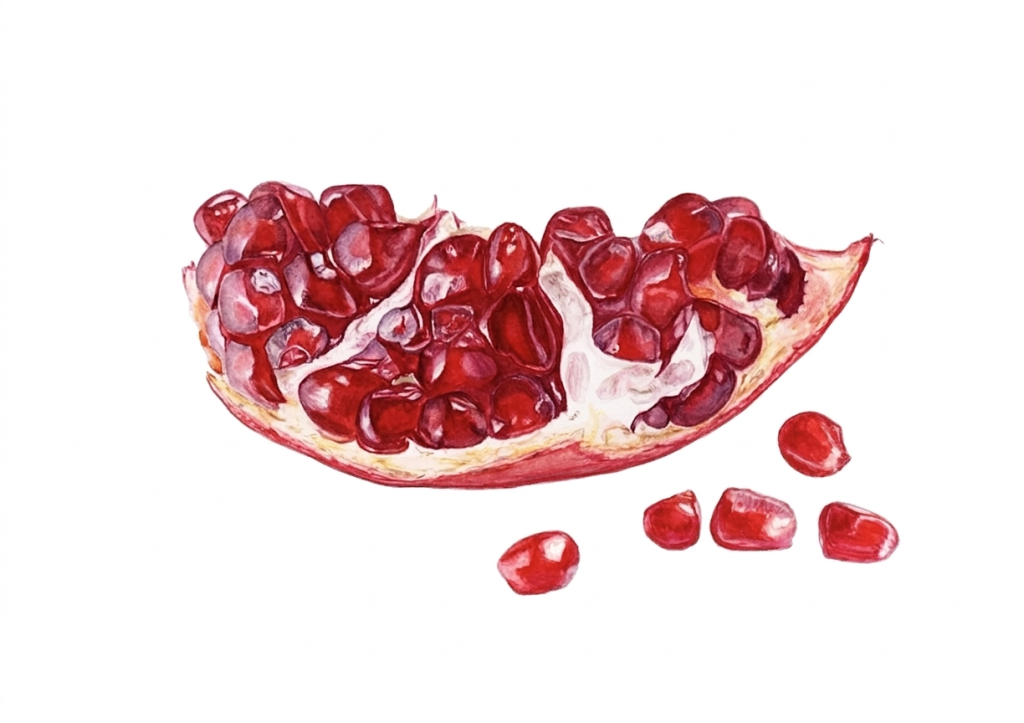
Pomography by Inessa Falina
There is something slightly dangerous about looking at a pomegranate for too long.
At first, you see a beautiful red fruit with a lovely shape and smooth, glowing skin. That was what attracted me when I first started painting them. I loved their deep colour and their almost sculptural form, but then I started looking more closely — at the texture of the skin, the tiny marks and imperfections, the subtle changes of colour and the way the light moved across the curved surface.
Suddenly, one pomegranate wasn’t enough.
I wanted to paint another one, and then another, because every fruit had something different to show me.
Eventually, I became curious about what was happening underneath that beautiful skin. I started painting cracked pomegranates and pieces of pomegranate, and that opened up a completely different world. There were membranes, layers, strange little spaces and irregular shapes. The fruit that had looked so solid and perfect from the outside was actually full of complexity.
And then there were the seeds.
This was when I became completely fascinated. Some were deep red, some pink, some almost transparent. They caught the light differently and each one had its own shape. To me, they looked like little jewels, all packed together inside the fruit.
Later I started painting the flowers too.
When I look back, I realise that my relationship with pomegranates developed simply because I kept looking. I didn’t decide one day that I was going to create a whole body of work about them. Each painting led me to another question, and each answer gave me something else to look at.
Uzbekistan
My fascination became even stronger when I travelled to Uzbekistan.
Pomegranates are everywhere in Uzbek decorative art, traditional patterns and embroidery, and they have long been associated with abundance, fertility and richness. But when I was there, I wasn’t thinking about any of that in an academic way. I was looking at them as an artist.
I was noticing the colour, the shapes, the way they appeared in markets and gardens and the details I might later want to paint.
Last year, during my visit to Uzbekistan, I bought my first ceramic pomegranate.
I simply couldn’t resist it.
That one ceramic pomegranate has now become a small collection. I have pomegranates from Andalusia, Georgia, Uzbekistan and Turkey, and I love the fact that every one of them is different. They come from different places and have completely different personalities.
Since then, I’ve found pomegranates in different places, and each one brings back a little memory of where it came from.
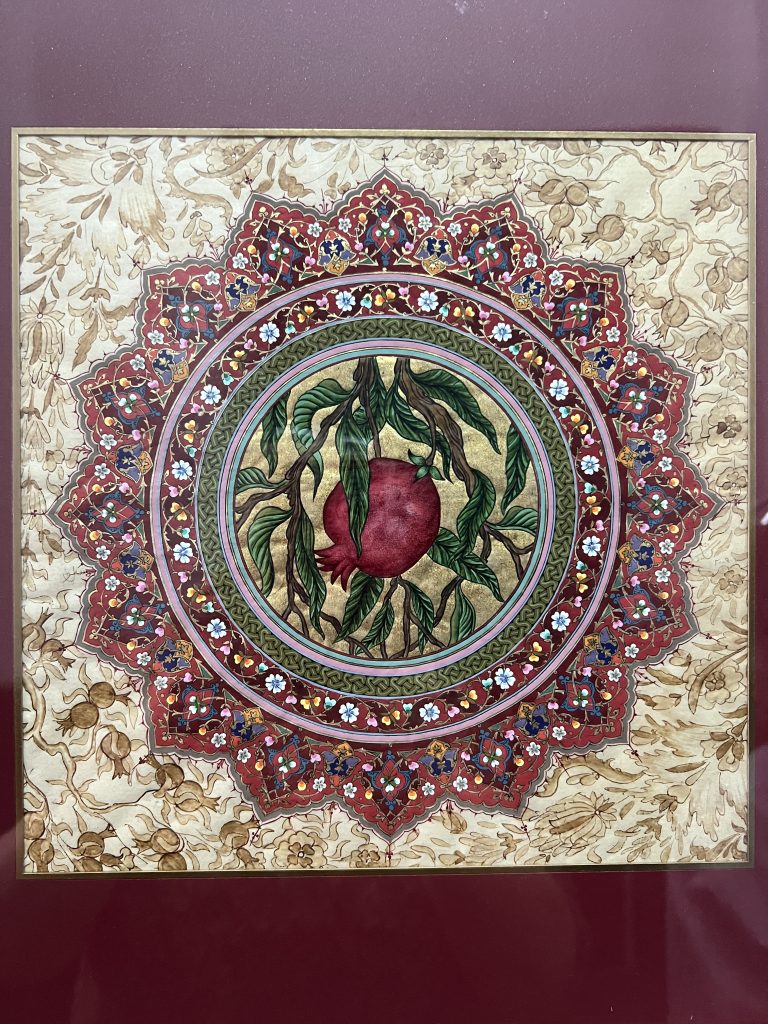
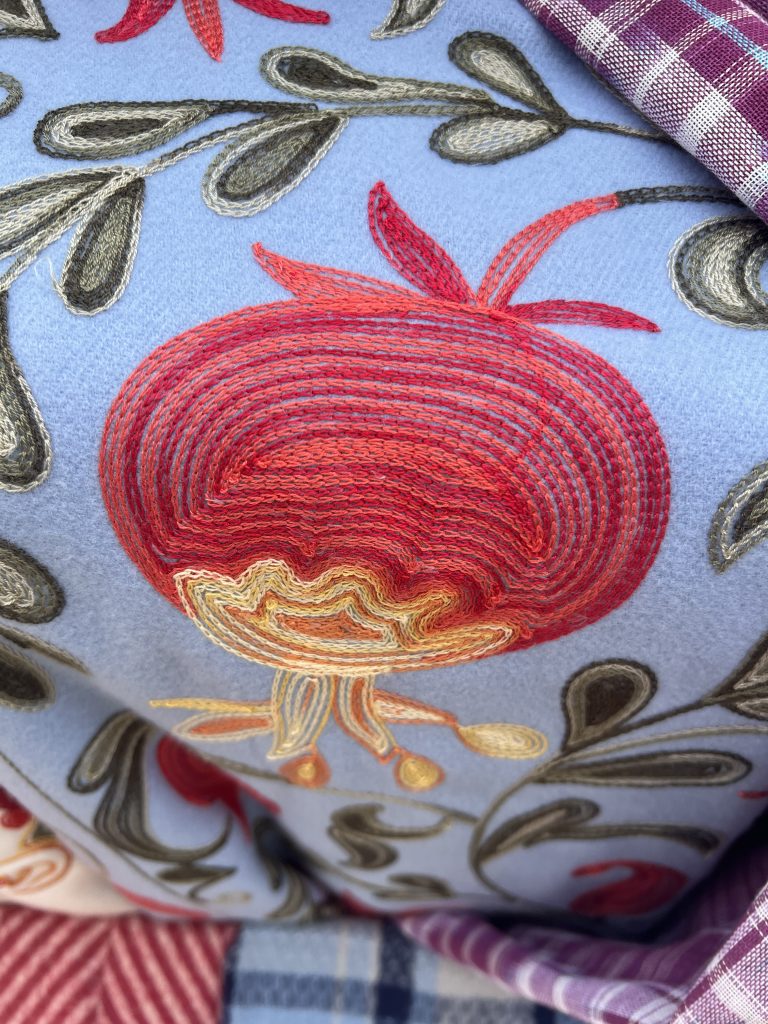
Pomegranates in Uzbekistan culture
A garden in Tbilisi
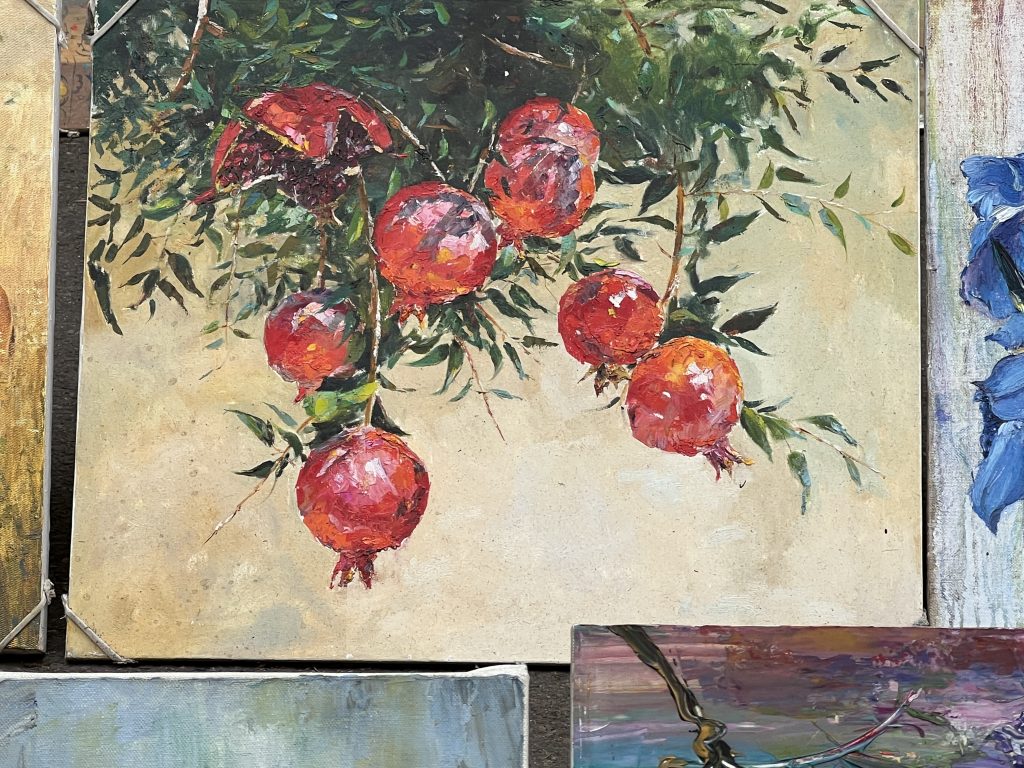
I was walking through the historic centre of Tbilisi when I noticed a large old house hidden behind a high fence. Through the bars I could see a garden overflowing with pomegranate trees, their branches heavy with ripe fruit. It was harvest time, and the pomegranates seemed to be everywhere, glowing among the leaves.
I stopped and looked at them for a while. There was no way I could photograph them properly from the street, and I really wanted to get closer.
Nearby, a man was squeezing fresh pomegranate juice. I gathered my courage and went over to ask if he might be the owner of the house. I explained that I was an artist and that I would love to photograph the pomegranates as references for my paintings.
I was lucky – he was the owner.
He opened the gate and invited me into the garden, telling me I could take as many photographs as I wished. I walked among the trees with my camera, looking at all the fruit and trying to take everything in.
Among all those branches, I found a pair of pomegranates that immediately caught my attention. There was something about them that made me stop and look for a long time.
The man noticed how interested I was. He picked the two pomegranates from the tree and handed them to me. Before I left, he offered me a glass of freshly squeezed pomegranate juice.
I still think about that moment. There was something very simple and generous about it — someone opening his gate, allowing a stranger into his garden and happily sharing what he had.
That experience became The Elegance of Openness.
The painting carries that moment for me: generosity, trust and the quiet beauty of being welcomed into someone else’s world. I also magnified the pomegranate seeds slightly in the painting because I wanted to capture all those beautiful little changes of light and shade that you notice when you look closely.
The painting has a new home now, but the memory has stayed with me.
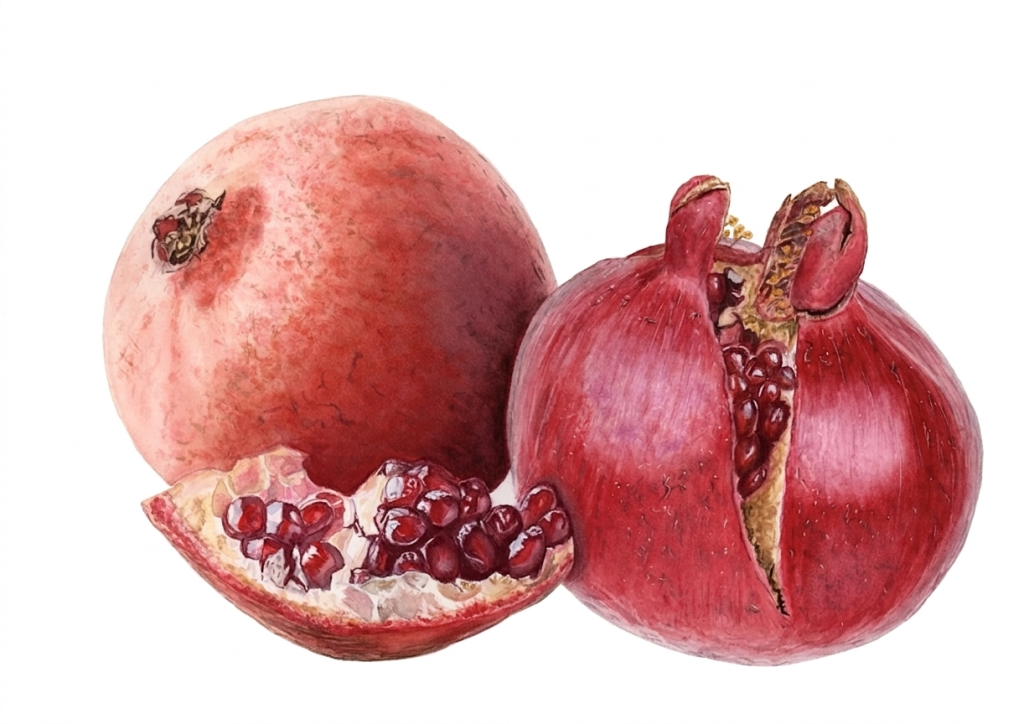
The Elegance of Openness
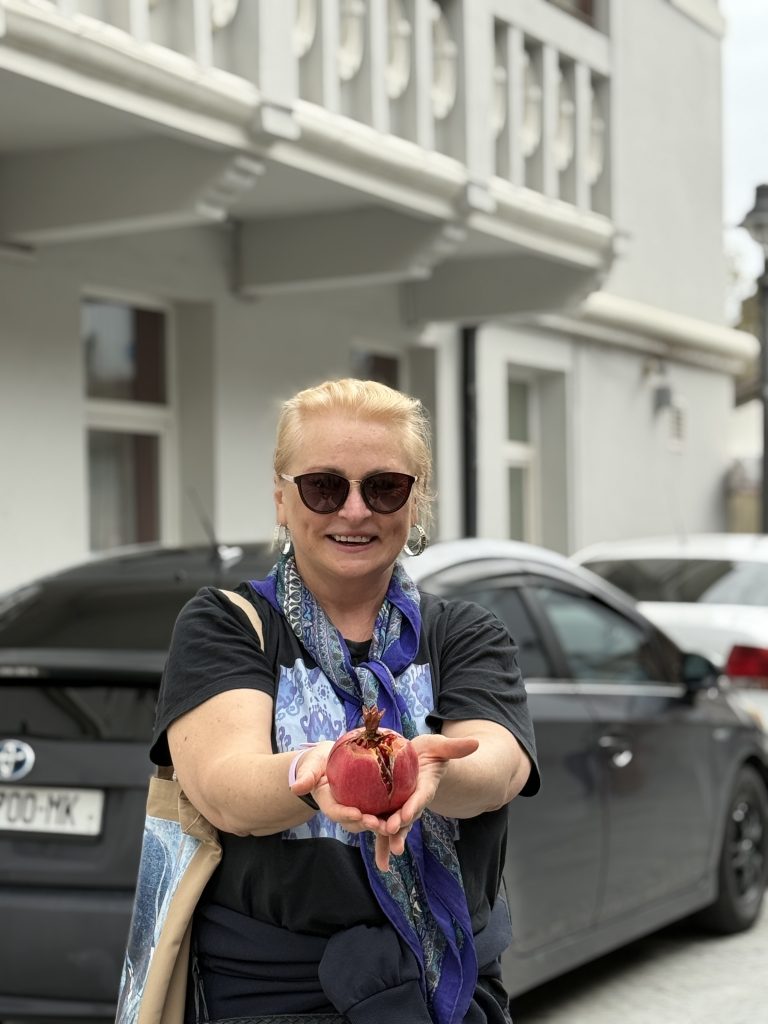
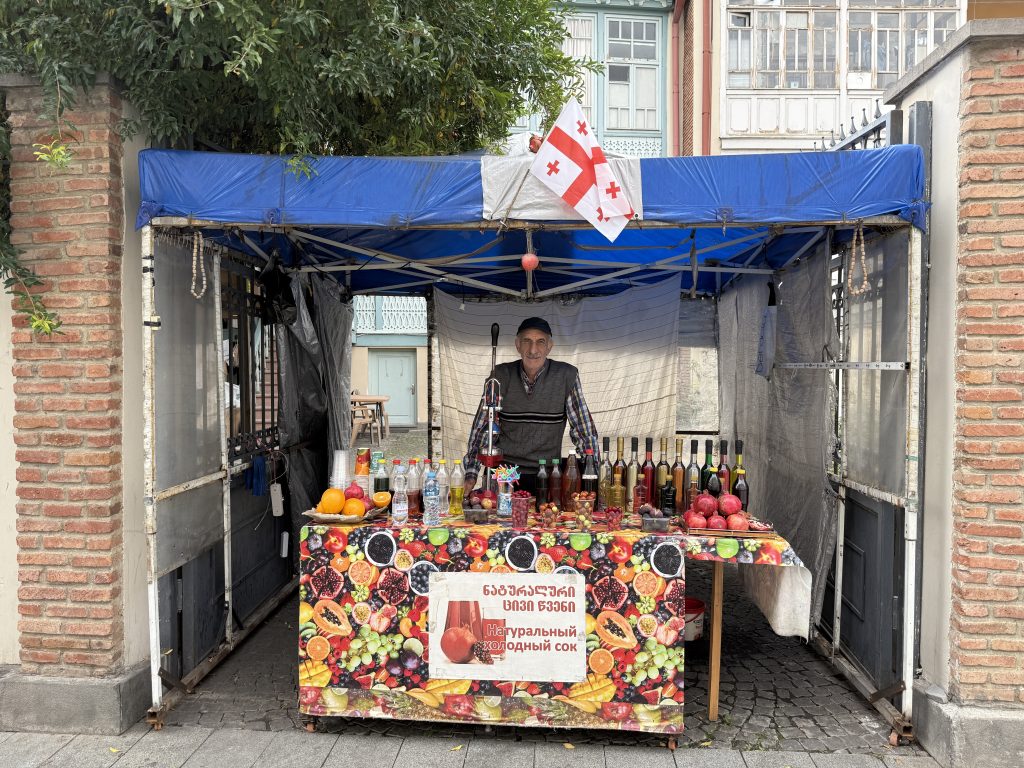
In Tbilisi Old Town
The Elegance of Openness
The Elegance of Openness is one of my favourite pomegranate paintings.
I think the name came naturally from that experience in Tbilisi. A pomegranate opens and reveals something beautiful that you couldn’t see before. In my memory, a garden gate opened and suddenly I could see something I would otherwise have missed.
I like that connection between the fruit and the experience.
There is also something about painting an opened pomegranate that I find much more interesting than painting a perfect, untouched one. Once it opens, you see its character.
The painting has a new home now, but I still love knowing that this little piece of my pomegranate story is somewhere in the world.
When pomegranates started to have personalities
The more pomegranates I painted, the more I started to see them almost as characters.
Some looked elegant. Some looked rather cheeky. Others seemed dramatic or completely out of control.
That was when Juicy Scandal appeared.
I wanted to paint an exploded pomegranate — something playful, slightly outrageous and full of movement. It was quite different from the carefully observed whole fruits I had started with.
There is a funny story behind it.
I had finished the painting the evening before I was meeting a collector, but I was still thinking that I needed to add more shades and make a few changes. The next day he asked me what I was working on, so I showed him the painting on my phone.
I explained that I had only just finished it and that I still wanted to make some adjustments.
He looked at it and said, “I am buying it.”
I told him again that I still wanted to work on it.
He said, “I am buying it.”
And then he said something that made me laugh. He told me, “This picture is very close to my personality. I love it, and I am buying it.”
I had been looking at the painting thinking about what still needed to be changed. He was looking at it and seeing himself in it. That made me smile.
Perhaps that is one of the nicest things that can happen to a painting — when someone looks at it and recognises a little bit of themselves there. And in this case, I think the pomegranate had found exactly the right person.
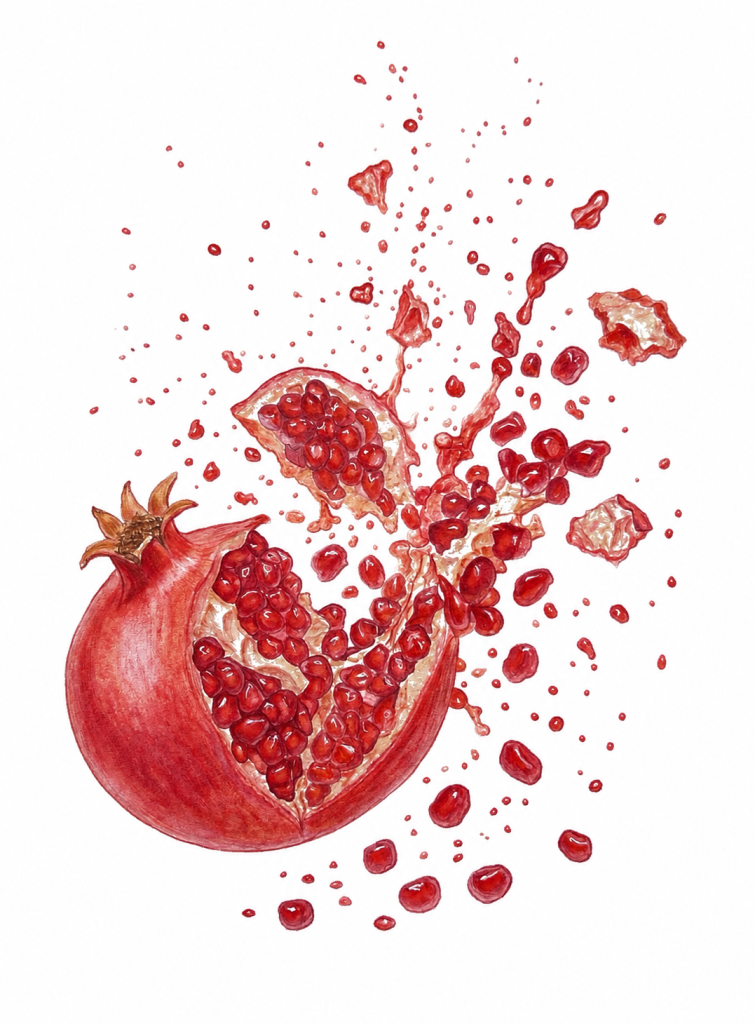
Juicy Scandal by Inessa Falina
Juice and the City
After painting so many pomegranates, I found myself becoming more and more interested in what was inside them. I had painted whole fruits, cracked fruits and pieces of fruit, but somehow I kept coming back to the seeds.
I couldn’t stop looking at them.
They were so beautiful on their own — different shades of red and pink, some almost transparent, catching the light in different ways. To me, they looked like tiny jewels, almost like nature’s jewellery.
That is how Juice and the City came about. I painted four seeds on a white background and the same four on black. I love how differently they look together. The white version feels fresh and delicate, while the black gives the seeds a little more elegance and drama, almost as if they have dressed up for a night out in the city.
And then my daughter gave the painting its personality.
She looked at the black version, pointed at one of the seeds and said, “Mommy, this is definitely Samantha from Sex and the City.”
I had to laugh. By then I had already started seeing pomegranates as characters, but suddenly one tiny seed had become a character of her own.
I love that these paintings came from something so small. Just four seeds, carefully observed, and yet each one seems to have its own shape, light and personality. It reminds me how much beauty you can find in the smallest details when you really take the time to look.
Once I became fascinated by the seeds, I started wondering how little I could show and still make a painting interesting.
That led to Juice and the City.
There are only four pomegranate seeds on a white background and four on a black background. The two paintings are designed to complement each other, and I love seeing them together.
With only four seeds, every little difference becomes important. The shape, the colour, the transparency, the tiny reflection of light — suddenly a single seed becomes something worth really looking at.
My daughter once looked at one of the seeds and said, “Mommy, this is definitely Samantha from Sex and the City.”
I laughed because, somehow, I could see what she meant.
By then I had already started seeing pomegranates as characters, so perhaps it wasn’t surprising that she saw a personality in one of the seeds too.
It made me realise how much personality can exist in something so small.
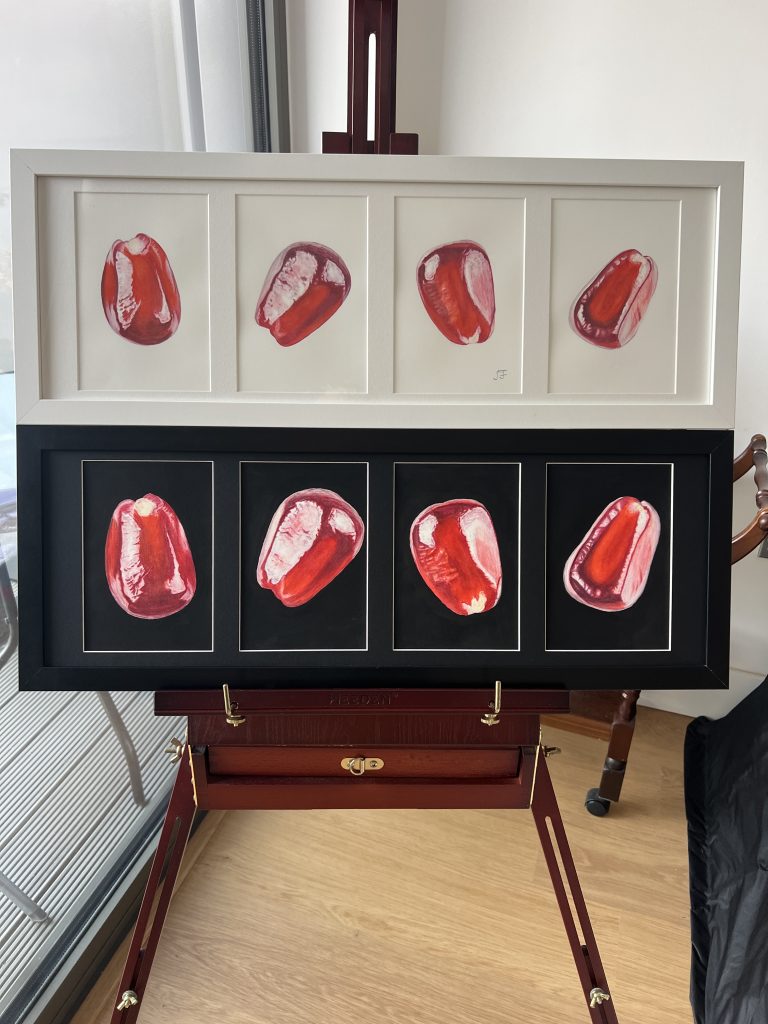
Juice & The City
Eight Seeds
That fascination eventually led to Eight Seeds, another painting where the seeds became the whole subject.
I love painting them because they really do look like jewels to me. Their colours can be incredibly rich, but at the same time they have that delicate, almost transparent quality. There is something satisfying about taking something tiny and giving it enough attention that it becomes the centre of the painting.
A digital copy of Eight Seeds now lives in Australia, and I’m so pleased about that. It makes me happy to think that these eight tiny pomegranate seeds, which started on my painting table in London, have travelled all the way to the other side of the world.
One of my pomegranate paintings also became part of my diploma work, which made me realise that these fruits had become much more important in my artistic journey than I had ever expected.
And that is probably what I find most interesting about painting them.
The more closely I look, the less ordinary they become.
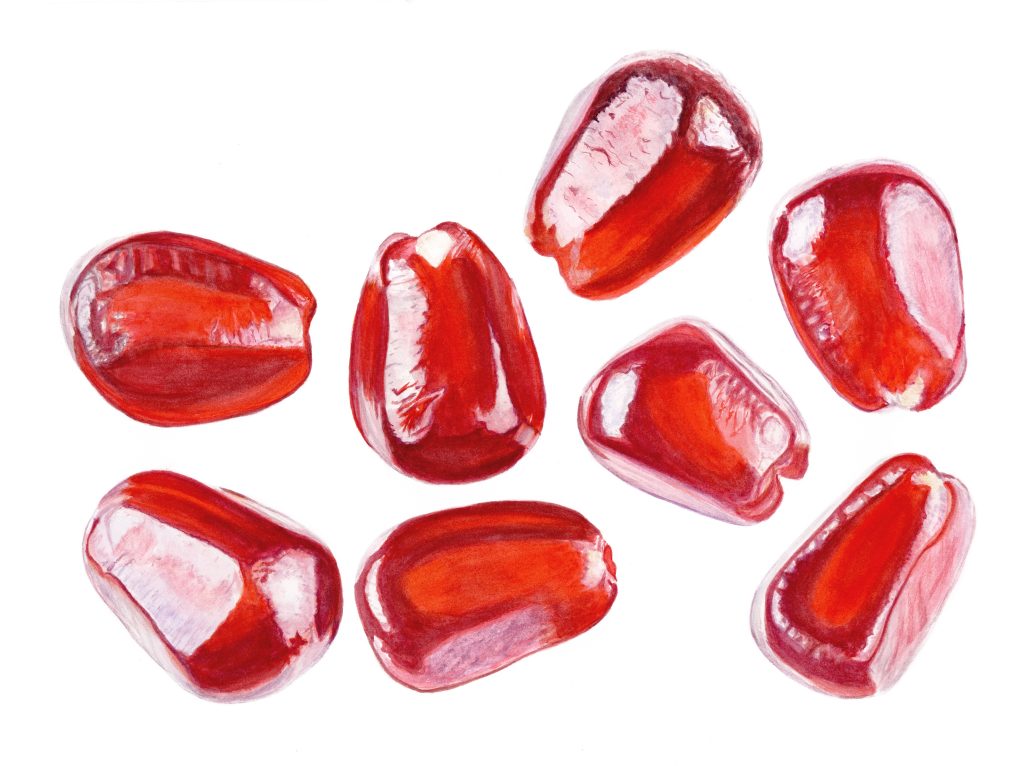
Eight Seeds
Pomography
Eventually I gave this whole pomegranate world a name: Pomography.
I like the name because it has a sense of fun about it, which suits the way my relationship with pomegranates has developed.
I started with the whole fruit because I loved its shape and colour. Then I wanted to see what was underneath the skin. Then I became fascinated by the seeds. Then came the flowers. Somewhere along the way, the pomegranates started becoming characters, memories and stories rather than simply subjects to paint.
And perhaps that is why I keep coming back to them.
A whole pomegranate can be beautiful, but once you break it open, you discover so much more. You see the membranes, the layers, the strange little spaces and those jewel-like seeds hidden inside.
You can look at one fruit again and again and still find something new.
I think that is what I love most about painting. Not finding something once, but being curious enough to keep looking.
And perhaps that is the real reason pomegranates look better when they’re broken.
ABOUT THE AUTHOR
Inessa Falina is a London-based botanical artist and teacher. A fellow of the Linnean Society in London and member of the Chelsea Physic Garden Florilegium Society and Society Botanical Artists, she has exhibited at The Mall Galleries and Chelsea Old Town Hall, with work held in private collections across Europe, the USA and Australia. Through her art and teaching, she helps people slow down, observe nature deeply and find calm through the practice of painting. You can follow her work on Instagram at @inessa.falina
— Inessa