‘I recently read a simple comment that stayed with me.
A woman shared that after a good result in her business, she bought herself a dress. She knew she “needed” a jumper more — something sensible and practical. But she chose the dress’
The woman who bought a dress
Then she added one short sentence that carried more weight than it first seemed to hold.
People do not buy what they need. They buy what they want.
At first, it sounds like an observation about shopping. Something light. Almost obvious.
But the more I turned it over, the more I realised it is not really about shopping at all.
The quiet force beneath our choices
We like to believe that our decisions are practical. Based on logic, usefulness and real necessity.
And perhaps some of them are.
But most of us know there is another layer operating underneath that story. Something quieter, but often far more powerful.
Attraction.
Not the dramatic kind. The quiet, almost instinctive kind. The moment when something simply feels right — a form, a colour, an atmosphere — without needing to explain itself in rational terms.
This is where the real tension appears. Between what makes sense and what we are drawn to. Between what we think we should choose and what we actually choose when we are honest with ourselves.
Most of us know this tension very well.
We make the practical decision and still glance at the other one. We act responsibly and still think about the alternative we left behind. There is always a quiet negotiation happening underneath the surface of these moments.
What happens when nobody needs a painting
I see this clearly in my own work as a botanical artist.
Nobody needs a painting of a plant. A home functions perfectly without one. A wall does not require art in order to exist as a wall.
And yet people choose to live with it.
Not because it solves a problem. Because it changes how a space feels.
Over the past five years — studying botanical painting formally, earning a Diploma with the Society of Botanical Artists and placing work in private collections across Europe, the United States and Australia — I have watched this happen many times. People do not arrive at a painting because they have a gap to fill. They arrive because something pulls them.
The decision is rarely logical. And it is almost never slow.
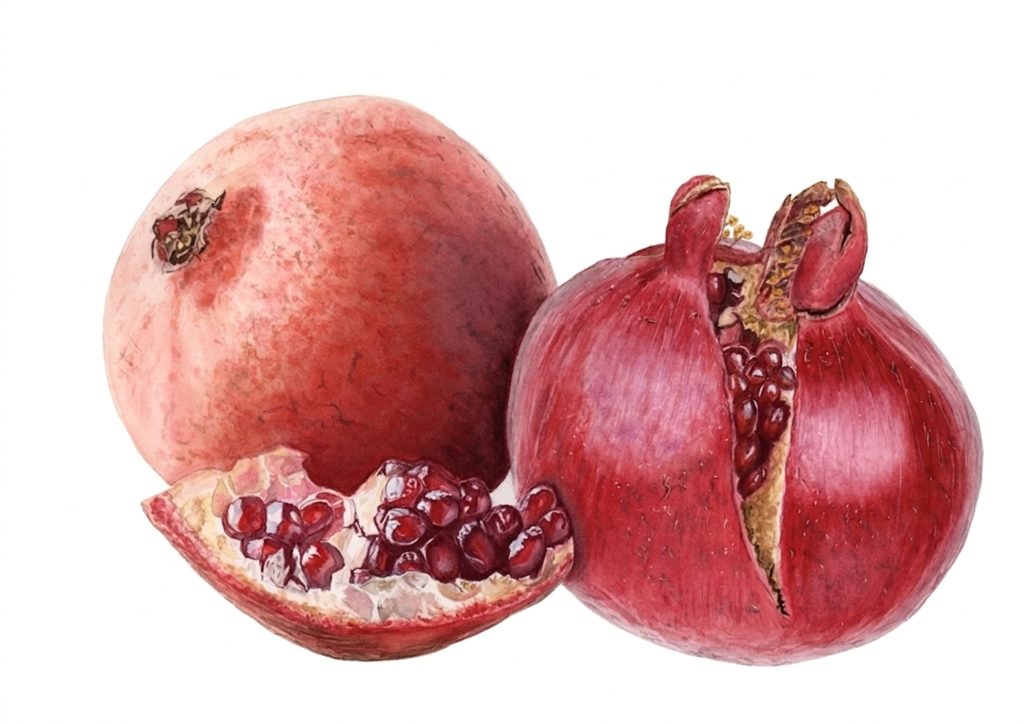
The Elegance of Openness
The man who paid at the dinner table
I remember a dinner with friends in London. A man I had never met before asked what I did. I told him. He looked at my Instagram quietly, scrolling through.
Then he said he wanted to buy my The Elegance of Openness painting.
I thought it was the kind of thing people say to be kind. A generous compliment at the end of a long evening.
He was completely serious. He made a bank transfer at the dinner table that same night.
The painting was committed to two exhibitions at the time. I asked if he would mind waiting two months.
He said he would wait.
He had seen the work on a small phone screen, in a dimly lit restaurant, surrounded by conversation and wine. And he had decided.
That is not a practical decision. It is not a need-based decision.
It is what happens when something is simply recognised.

Picture sold
Recognition, not necessity
This word — recognition — is the one I keep returning to.
When people respond to a painting, they are not usually reacting to its technical accuracy alone, though that matters. They are responding to something they already carry inside themselves. A feeling they know but have not found a place for. A connection to something natural in a life that is often very far from nature.
A few years ago, a lady I knew through church flower arrangements in London asked to see the work I was carrying back from an exhibition. She looked through my Instagram quietly, taking her time.
Then she made her choice.
She bought the Crab Apples: Evolution Trilogy — three small watercolours, framed together as one work, selected for the SBA Plantae 2023 exhibition at Mall Galleries in London.
Her reason was very simple.
“I am buying this one because I love its story.”
She framed it and hung it in her breakfast room. The heart of her home, she told me. The place where all life goes.
Not a spare wall. The centre of the house.
Not filling a gap. Choosing something that felt meaningful.
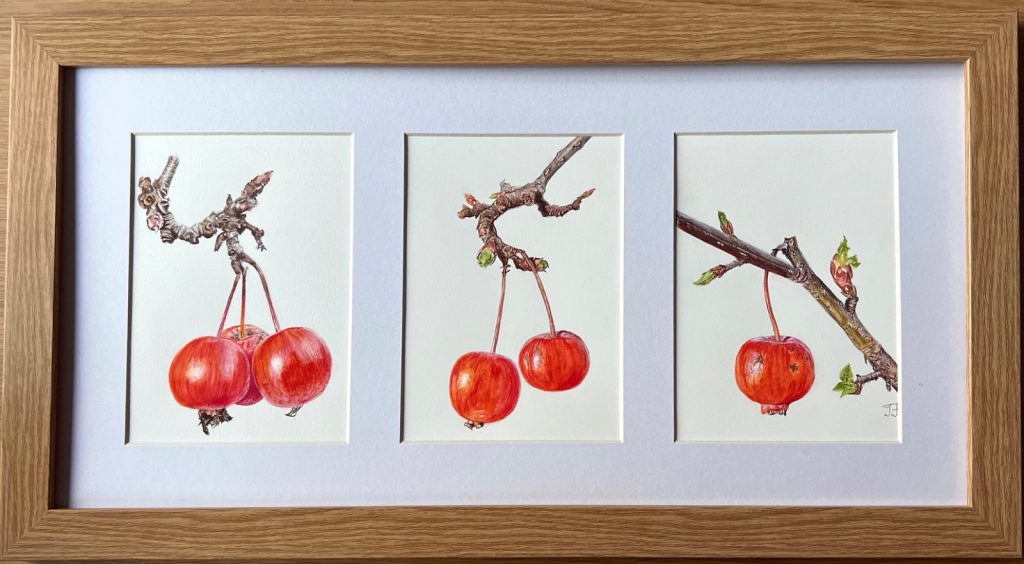
Crab apples by Inessa Falina
What botanical painting does to a space
When I paint, I am not trying to improve nature or make it into something else. I am observing it closely — the structure of a leaf, the way light moves across a petal, the patience a plant requires if you want to understand it properly — and translating that attention into paint.
What comes through the work is not only accuracy.
It is presence.
A botanical painting introduces something living and unhurried into a space that is often moving very fast. It asks the eye to slow down. It brings attention to something most of us walk past every day without seeing.
At the SBA Plantae 2025 exhibition at Mall Galleries, a man asked me what I was painting at the moment. I showed him a photo on my phone — a piece I had finished the previous evening.
He said immediately: “I am buying it.”
A second person from the same group wanted it too.
It was already taken.
That is not about need. It is about something far more immediate. The pull of a feeling. A moment of connection to something natural, caught in paint, in a world that often has very little stillness in it.
Not filling a gap
This is why I keep returning to that simple sentence about the dress.
People do not buy what they need. They buy what they want.
And want, I have come to believe, is not a small thing. It is not a weakness or an indulgence. In many cases it is closer to the truth of who we are than the careful, practical decisions we make around it.
When someone brings a botanical painting into their home, they are not solving a problem. They are responding to something they already recognise inside themselves. A desire for stillness. A connection to the natural world. A feeling that this particular space should hold something living, even when nothing is growing there.
The choice reveals something. Not what is necessary, but what is valued. Not what fills a wall, but what fills a room with a different quality of attention.
Collecting art is not an extra decision. It is a personal one. It reflects sensitivity and the desire to live with something that carries emotional weight rather than only function.
And perhaps that is what makes art quietly essential in a different way.
Not because it is needed.
But because, for the right person, in the right moment, it is simply known.
ABOUT THE AUTHOR
Inessa Falina is a London-based botanical artist and teacher. A fellow of the Linnean Society in London and member of the Chelsea Physic Garden Florilegium Society and Society Botanical Artists, she has exhibited at The Mall Galleries and Chelsea Old Town Hall, with work held in private collections across Europe, the USA and Australia. Through her art and teaching, she helps people slow down, observe nature deeply and find calm through the practice of painting. You can follow her work on Instagram at @inessa.falina
— Inessa