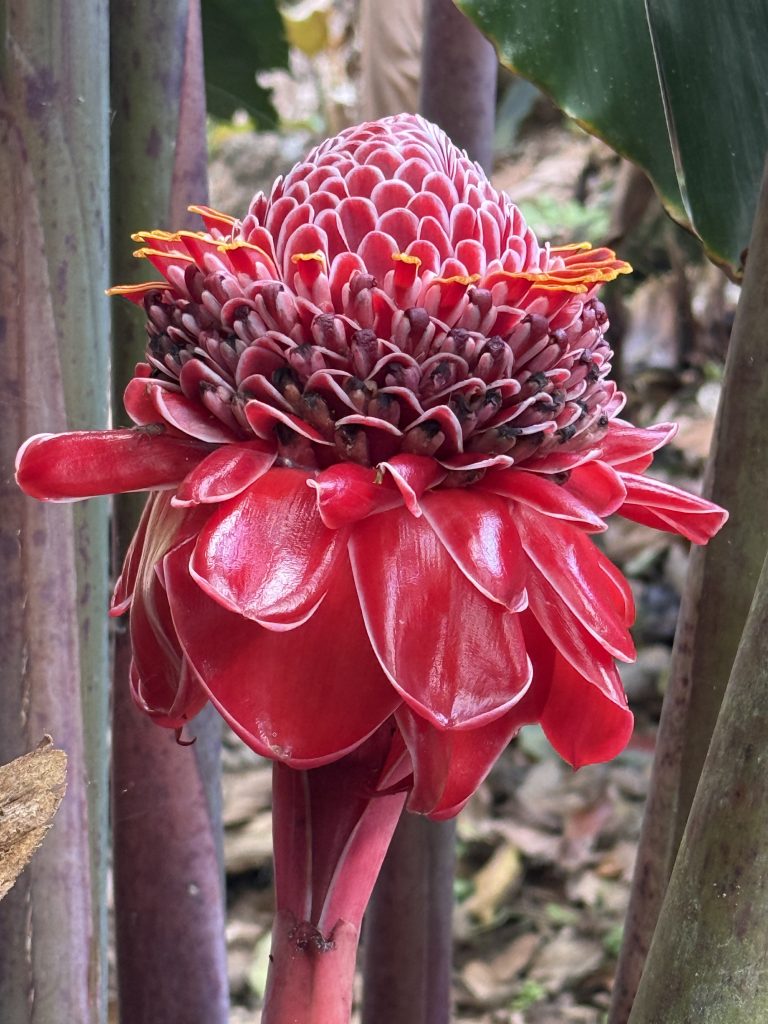
Develop an Artist’s Eye – Ginger Flower from Galápagos Islands
When did you last really look at a flower?
Since becoming a botanical artist, I have realised that I no longer look at plants in quite the same way. What used to be simply a beautiful flower or an interesting leaf has become something I want to investigate. I notice the way the light moves across a petal, the subtle change from one green to another, the small shadow underneath a leaf or the way an edge becomes softer as it turns away from the light.
Quite often, I find myself stopping to look at something when I am not even thinking about painting. It might happen in a garden, at a market or simply while walking down the street. Something catches my eye and I want to understand why I find it interesting. I may notice an unusual combination of colours, an unexpected shape or the way a plant casts a shadow on a wall. I sometimes think that becoming a botanical artist has made ordinary life considerably more distracting, although it has also made the world much more interesting.
For me, this is at the heart of developing an artist’s eye. It is not simply about becoming better at drawing or learning how to mix beautiful colours. It is about learning to notice what is actually in front of you instead of relying on what your brain has already decided you are looking at.
Our brains are very good at shortcuts
We move through the world surrounded by an enormous amount of visual information, so our brains naturally simplify what we see. We recognise a tree as a tree, an apple as an apple and a green leaf as a green leaf without needing to examine every detail.
This is extremely useful in everyday life, but when you begin to paint, those shortcuts can sometimes get in the way.
If I look at a leaf and decide immediately that it is green, I may reach for a green paint and begin working. However, if I spend a little more time observing it, I may discover that the green is completely different in different areas. There might be warm yellow-green where the light reaches the surface, cooler blue-green in the shadows, a little brown around the stem and perhaps even a touch of violet where the light is weakest.
The leaf has not changed. I have simply looked at it more carefully.
That difference between recognising something and really observing it is one of the most important things we can develop as artists.
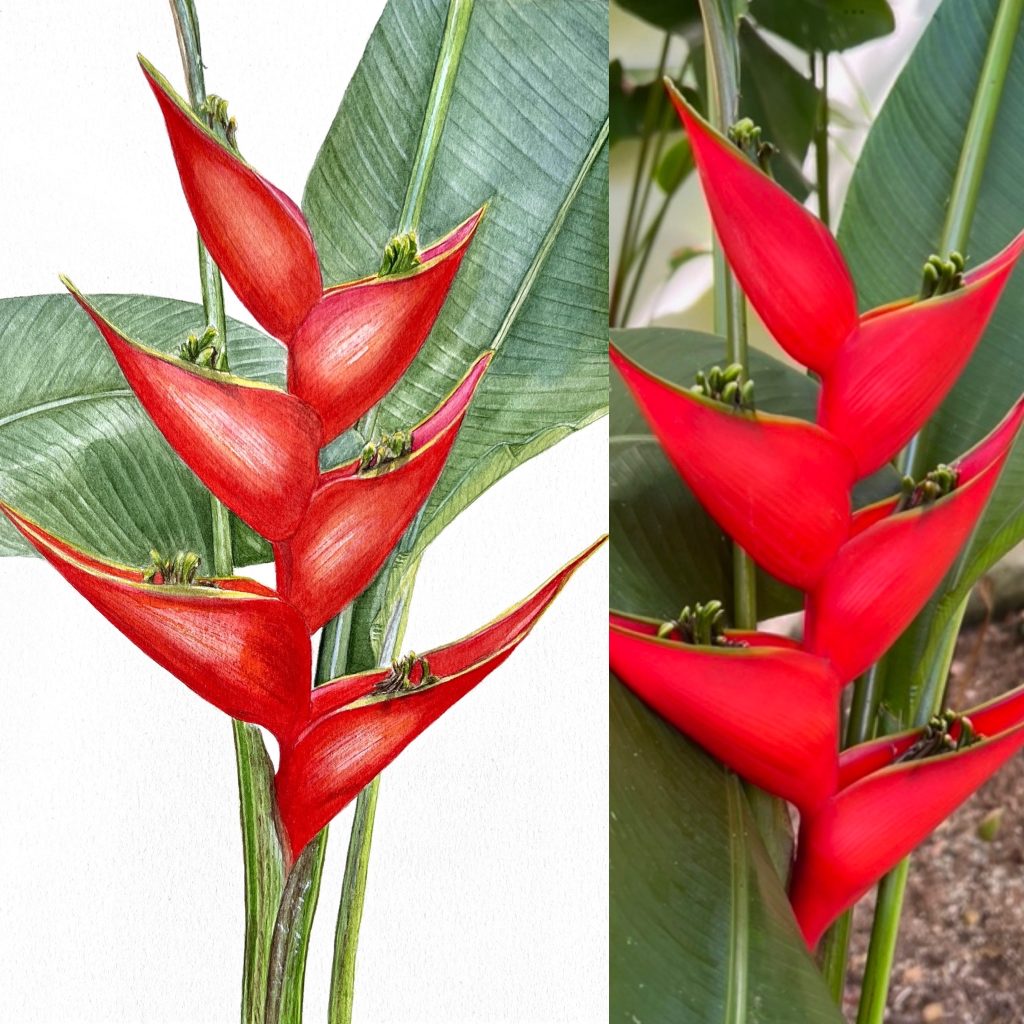
Heliconia by Inessa Falina and original Heliconia from Mexico
Don’t paint what you know
When we first start drawing or painting, it is very natural to paint what we believe something should look like. We have an idea in our minds of a flower, a leaf, an apple or a pear, and we unconsciously use that idea as our reference.
The problem is that nature is much more interesting than our mental picture of it.
A white flower is rarely simply white, because its petals may reflect the colours around them and contain warm and cool shadows. A red apple can contain several different reds as well as yellows, oranges, browns and cooler colours in the shadow. Even a seemingly ordinary green leaf can contain an extraordinary range of subtle variations.
When I am painting, I therefore try not to name a colour too quickly. Instead of deciding that something is green, I look at what is actually happening in front of me and ask myself how that colour changes across the surface, where it becomes warmer or cooler and what happens to it as the form turns away from the light.
It is a small change in the way we think, but it can make a very significant difference to the painting.
Look at what is around the subject
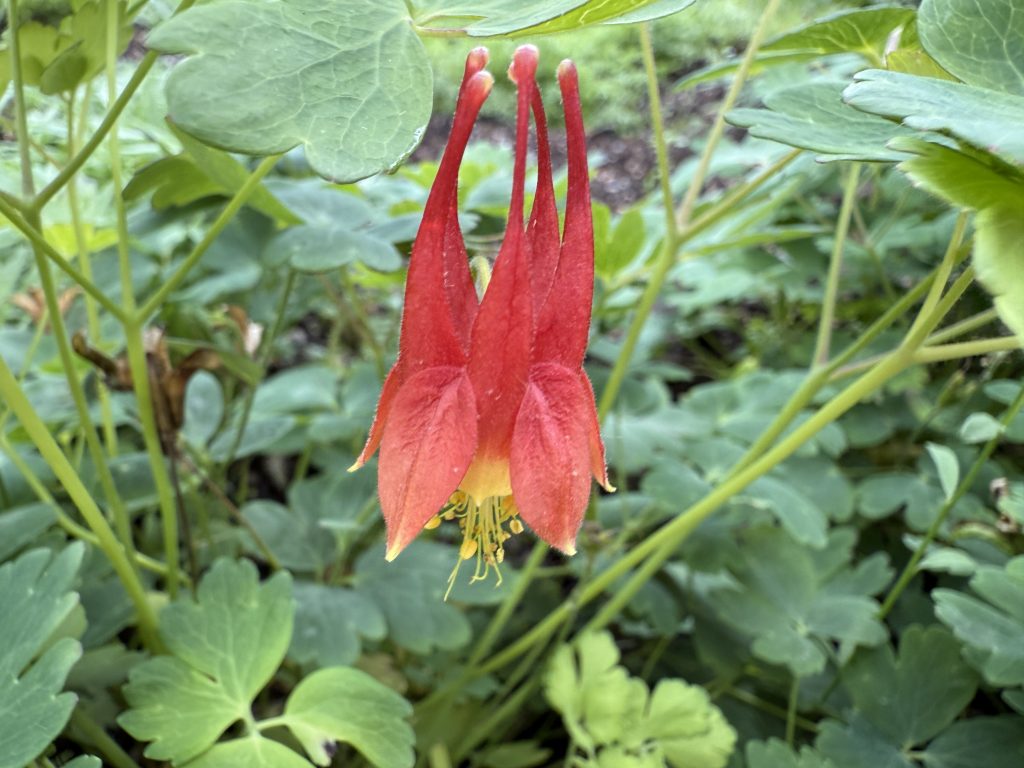
One of the things I find particularly fascinating about developing an artist’s eye is learning to pay attention to the spaces around the subject as well as the subject itself.
When we look at a flower, our attention naturally goes to the petals, the centre and the stem, but the spaces between these elements can tell us just as much about the shape and proportion of the flower.
Look at the little space between two petals, the opening between a leaf and its stem or the shape created where two leaves overlap. These areas are known as negative spaces, although I have always thought that the name makes them sound much less interesting than they actually are.
When I am checking a drawing, sometimes the easiest way to see whether something is correct is to stop looking directly at the object and look at the space beside it. If that little shape looks wrong, there is a good chance that something in the drawing needs adjusting.
It is a simple habit, but it can completely change the way you observe.
Look at what is around the subject
An artist’s eye is really about relationships
The more I paint, the more I realise that observation is not really about collecting hundreds of tiny details. It is about understanding the relationships between them.
How much darker is one area than another? How does the colour change as a petal curves away from the light? How does one leaf sit in front of another? Which edge is clearly defined and which one almost disappears into the surrounding space?
These relationships create the feeling of form, depth and light, and they are often much more important than the tiny details we are tempted to concentrate on.
This is why I believe that observation sits underneath technique. Of course, we need to learn how to control our brushes, mix colours and build up layers, but all of those skills become much more useful when we have learned to really see the subject in front of us.
You can practise without painting
The wonderful thing about developing an artist’s eye is that you can practise almost anywhere, and you do not even need to have a pencil or paintbrush with you.
The next time you are walking through a garden, choose one plant and spend a few minutes looking at it more carefully than you normally would. Notice the direction of the light, the colours hidden in the shadows, the different edges and the spaces between the leaves.
You could do the same thing in a market by looking closely at a piece of fruit, or while sitting in a café by noticing the way light falls across a vase of flowers.
Sometimes I actually think it is useful not to start drawing immediately. Simply looking, without trying to produce anything, can be a valuable part of learning to see.
With practice, you may find that you begin noticing these things without deliberately trying. A particular combination of colours might catch your attention, or the shadow of a plant on a wall might suddenly look like a beautiful composition.

Practice without painting
A little exercise for your artist’s eye
Choose one botanical subject and spend five minutes observing it before you begin to draw or paint. Start with the overall shape, then gradually look at the smaller forms within it, paying attention to the lightest and darkest areas as well as the subtle changes in colour.
Then look at the spaces around your subject and ask yourself what you had not noticed at first.
You could even make a small note of three discoveries. When you look at the same subject again the following day, you may find that there are three more.
This kind of observation may seem very simple, but it is through these repeated moments of attention that your way of seeing gradually changes.
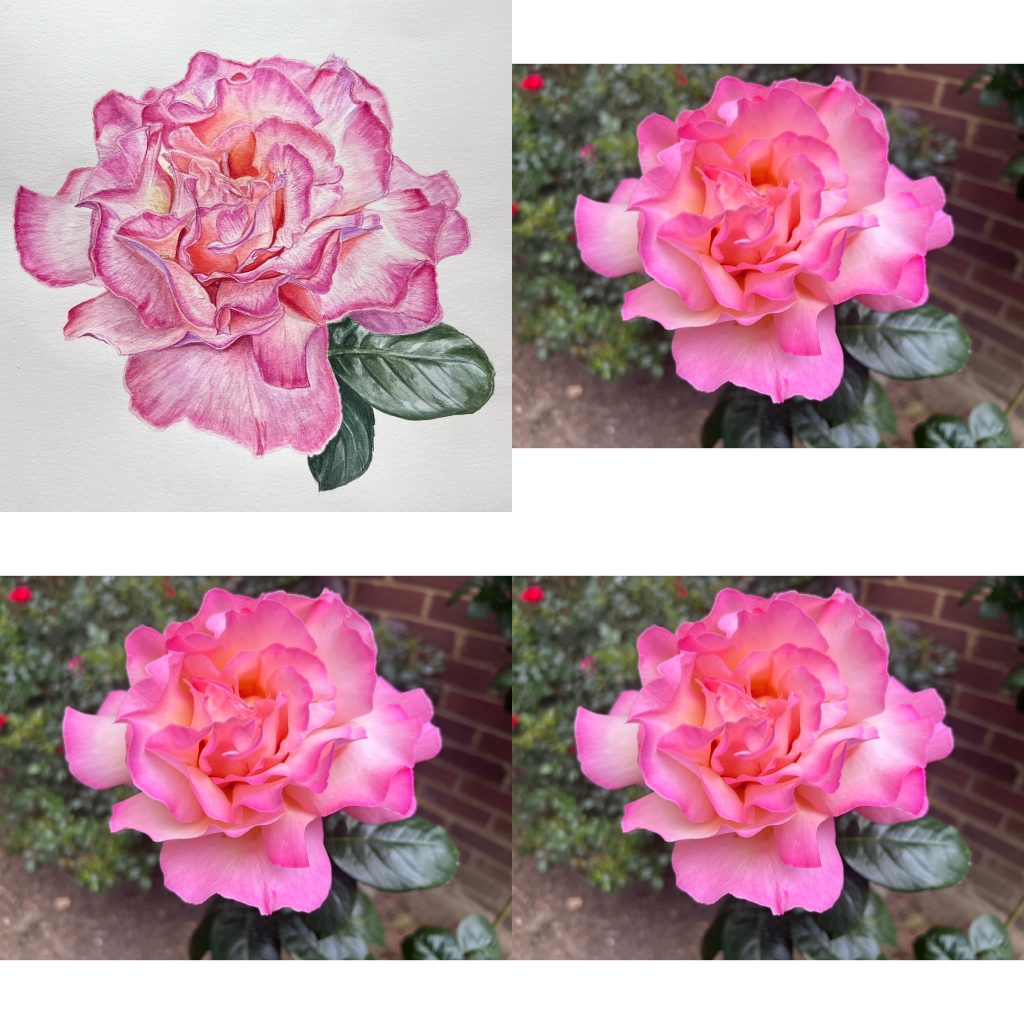
Rose by Inessa Falina and original rose from London garden
Seeing is part of becoming an artist
For a long time, I thought that becoming a better artist was mainly about improving my technique. I still believe that technique is important, and there is always something new to learn, but over time I have come to understand that observation is the foundation underneath all of it.
You cannot paint something you have not really seen.
Developing an artist’s eye is not about seeing more than everyone else. It is about becoming curious enough to look for a little longer, to question your first impression and to discover what is hiding inside something that initially seemed familiar.
Perhaps that is one of the greatest gifts that painting has given me. I have not simply learned to create images of the natural world; I have learned to pay much closer attention to the world itself.
And once you begin to look in this way, you may discover that there is far more to see than you ever imagined.
ABOUT THE AUTHOR
Inessa Falina is a London-based botanical artist and teacher. A fellow of the Linnean Society in London and member of the Chelsea Physic Garden Florilegium Society and Society Botanical Artists, she has exhibited at The Mall Galleries and Chelsea Old Town Hall, with work held in private collections across Europe, the USA and Australia. Through her art and teaching, she helps people slow down, observe nature deeply and find calm through the practice of painting. You can follow her work on Instagram at @inessa.falina
— Inessa